Ann Clin Microbiol 2025;29(2):9. Laser scattering signal amplification and deep learning for detection of Candida culture positivity in women with vaginal symptoms: a preliminary analytical and pilot clinical evaluation
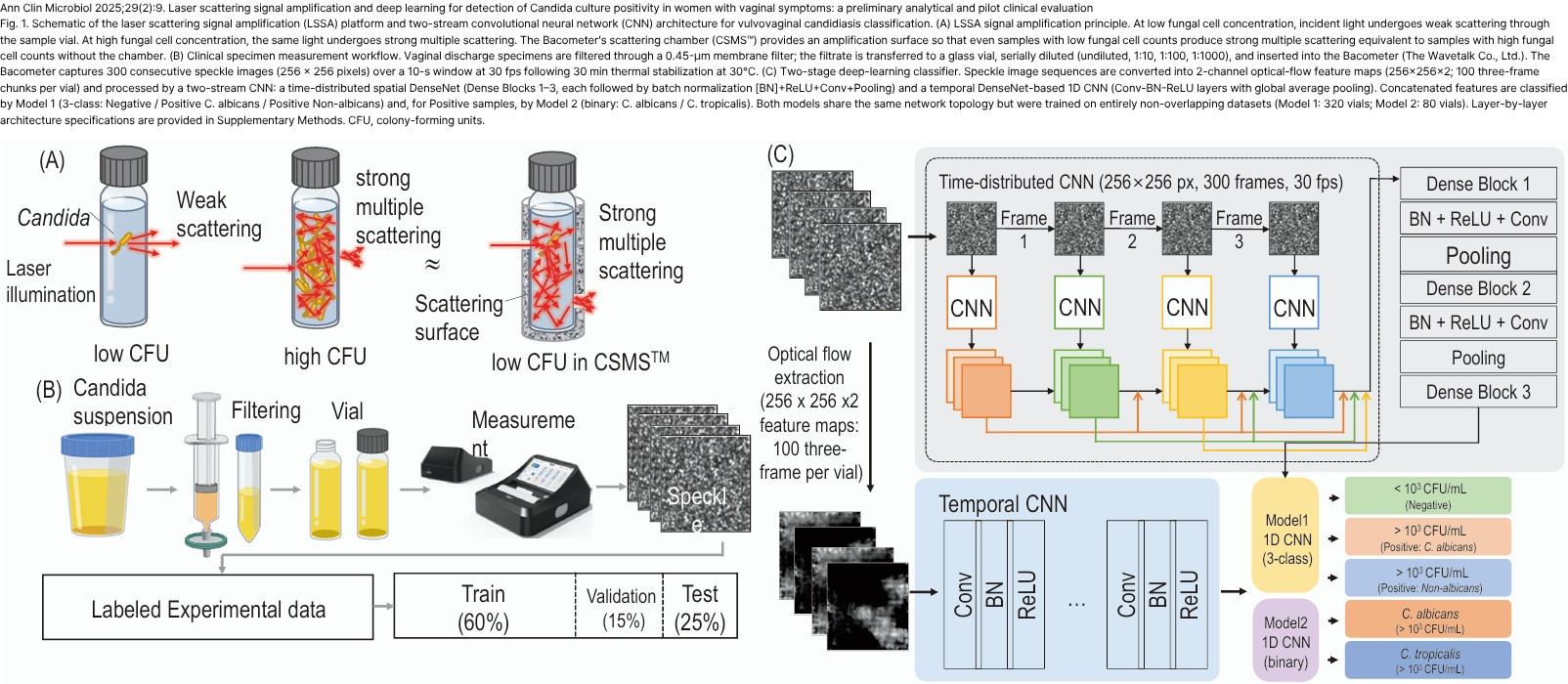
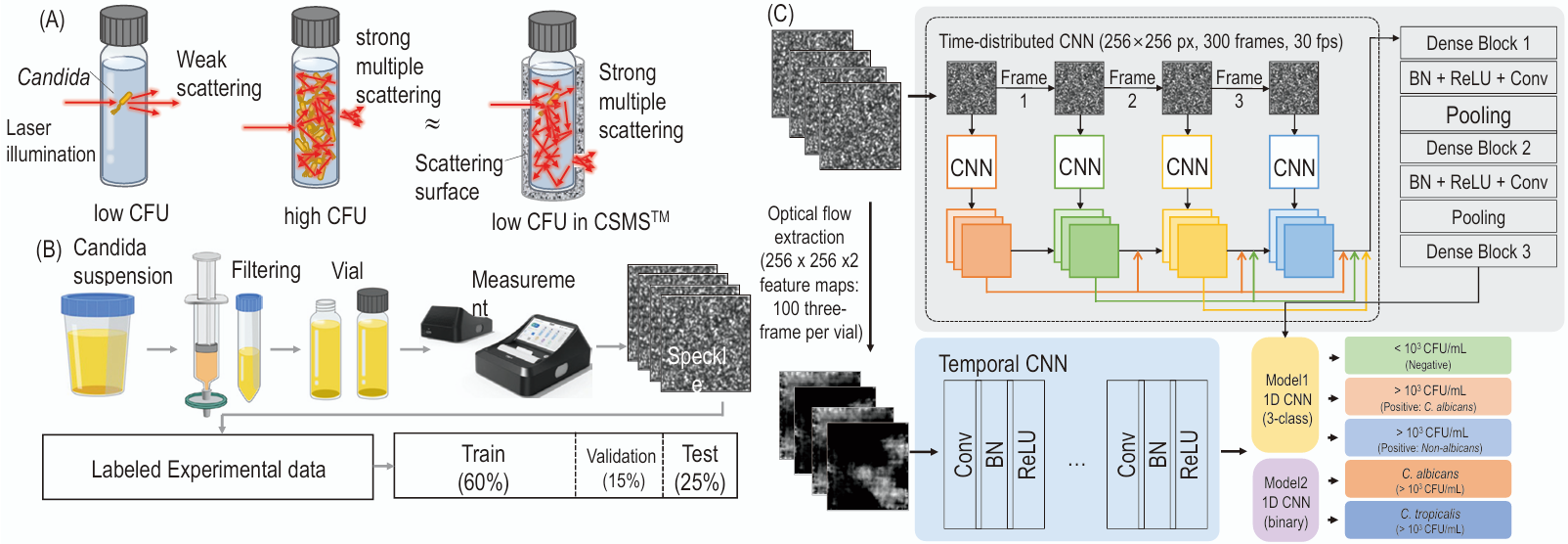
Fig. 1. Schematic of the laser scattering signal amplification (LSSA) platform and two-stream convolutional neural network (CNN) architecture for vulvovaginal candidiasis classification. (A) LSSA signal amplification principle. At low fungal cell concentration, incident light undergoes weak scattering through the sample vial. At high fungal cell concentration, the same light undergoes strong multiple scattering. The Bacometer’s scattering chamber (CSMS™) provides an amplification surface so that even samples with low fungal cell counts produce strong multiple scattering equivalent to samples with high fungal cell counts without the chamber. (B) Clinical specimen measurement workflow. Vaginal discharge specimens are filtered through a 0.45-µm membrane filter; the filtrate is transferred to a glass vial, serially diluted (undiluted, 1:10, 1:100, 1:1000), and inserted into the Bacometer (The Wavetalk Co., Ltd.). The Bacometer captures 300 consecutive speckle images (256 × 256 pixels) over a 10-s window at 30 fps following 30 min thermal stabilization at 30°C. (C) Two-stage deep-learning classifier. Speckle image sequences are converted into 2-channel optical-flow feature maps (256×256×2; 100 three-frame chunks per vial) and processed by a two-stream CNN: a time-distributed spatial DenseNet (Dense Blocks 1–3, each followed by batch normalization [BN]+ReLU+Conv+Pooling) and a temporal DenseNet-based 1D CNN (Conv-BN-ReLU layers with global average pooling). Concatenated features are classified by Model 1 (3-class: Negative / Positive C. albicans / Positive Non-albicans) and, for Positive samples, by Model 2 (binary: C. albicans / C. tropicalis). Both models share the same network topology but were trained on entirely non-overlapping datasets (Model 1: 320 vials; Model 2: 80 vials). Layer-by-layer architecture specifications are provided in Supplementary Methods. CFU, colony-forming units.