Annals of Clinical Microbiology, The official Journal of the Korean Society of Clinical Microbiology

6

Weeks in Review

4

Weeks to Publication
Indexed in KCI, KoreaMed, Synapse, DOAJ
Open Access, Peer Reviewed
pISSN 2288-0585 eISSN 2288-6850

Search Results for: Jong Hee Shin

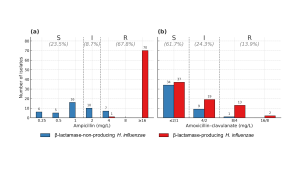
Prevalence and molecular characteristics of β-lactam resistance in non-typeable Haemophilus influenzae isolates in Korea

Original article Eun-Young Kim1, Yeon Chan Choi1, Hyeon Jin Choi1, Si Hyun Kim2, Jihyun Cho3, Seok Hoon Jeong4, Dokyun Kim4, Hyun Soo Kim5, Soo Hyun Kim6, Young Ah Kim7, Young Ree Kim8, Nam Hee Ryoo9, Jong Hee Shin6, Kyeong Seob Shin10, Young Uh11, Jeong Hwan Shin1 1Department of Laboratory Medicine and Paik Institute for Clinical Research, Inje University College of Medicine, Busan, Korea2Department of Biomedical Laboratory Science, Inje University, Gimhae, Korea.3Department of Laboratory Medicine, Wonkwang University Medical School, Iksan, Korea4Department of Laboratory Medicine and Research Institute of Bacterial Resistance, Yonsei University College of Medicine, Seoul, Korea5Department of Laboratory Medicine, Hallym University Dongtan Sacred Heart Hospital, Hallym University College of Medicine, Hwaseong, Korea6Department of Laboratory Medicine, Chonnam National University Medical School, Gwangju, Korea7Department of Laboratory Medicine, National Health Insurance Service Ilsan Hospital, Goyang, Korea8Department of Laboratory Medicine, Jeju National University College of Medicine, Jeju, Korea9Department of Laboratory Medicine, Keimyung University School
Read More »

Evaluation of VITEK 2 system and VITEK MS system for the identification of Haemophilus species: a diagnostic accuracy study

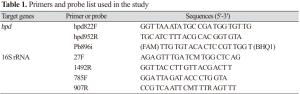
Original article Yeon Chan Choi1*, Eun-Young Kim1*, Hyun Jin Choi1, Si Hyun Kim2, Eunkyoung You1, Ja Young Lee1, Jihyun Cho3, Seok Hoon Jeong4, Dokyun Kim4, Hyun Soo Kim5, Soo Hyun Kim6, Young Ah Kim7, Young Ree Kim8, Nam Hee Ryoo9, Jong Hee Shin10, Kyeong Seob Shin11, Young Uh12, Jeong Hwan Shin1 1Department of Laboratory Medicine and Paik Institute for Clinical Research, Inje University College of Medicine, Busan, Korea2Department of Biomedical Laboratory Science, Inje University, Gimhae, Korea3Department of Laboratory Medicine, Wonkwang University Medical School, Iksan, Korea4Department of Laboratory Medicine and Research Institute of Bacterial Resistance, Yonsei University College of Medicine, Seoul, Korea5Department of Laboratory Medicine, Hallym University Dongtan Sacred Heart Hospital, Hallym University College of Medicine, Hwaseong, Korea6Department of Microbiology and Laboratory Medicine, Chonnam National University Medical School, Gwangju, Korea7Department of Laboratory Medicine, National Health Insurance Service Ilsan Hospital, Goyang, Korea8Department of Laboratory Medicine, Jeju National University College of Medicine, Jeju,

Read More »

Table 1. Articles published in Special Issues of Annals of Clinical Microbiology in 2024.

Ann Clin Microbiol 2025;28(1):6. ACM achievements in 2024 and future directions Download table Corresponding author Title Publication information Special Issue on Current Epidemiology and Diagnostics of Parasitic Infections in Korea Eun Jeong Won Challenging diagnosis of parasitic infection and practical guidance to clinical microbiology laboratories in Korea 27(2):39-40. Bong-Kwang Jung Intestinal helminth infections among health examinees: 10-year (2011–2020) nationwide observations in Korea 27(2):41-48. Woon-Mok Sohn Practical guide for the diagnosis of helminth ova in stools 27(2):49-67. Sun Huh Molecular diagnosis of parasitic diseases in Korea 27(2):69-79. Min-Ho Choi Serological diagnosis of tissue-invading parasites in Korea 27(2):81-91. Jong-Yil Chai Anisakidosis in humans and animals and detection of anisakid larvae in fish and cephalopods in Korea: a literature review (1971-2022) 27(2):93-130. Eun-Taek Han Malaria diagnostics: from traditional techniques to cutting-edge solutions 27(3):155-170. Special Issue on Current Epidemiology and Laboratory Diagnosis of Fungal Infections in Korea Jayoung Kim Fungal infections: rising threats, diagnostic

Read More »

ACM achievements in 2024 and future directions

Editorial Hae-Sun Chung Department of Laboratory Medicine, Ewha Womans University College of Medicine, Seoul, Korea Correspondence to Hae-Sun Chung, E-mail: sunny0521.chung@ewha.ac.kr Ann Clin Microbiol 2025;28(1):6. https://doi.org/10.5145/ACM.2025.28.1.6Received on 14 March 2024, Revised on 16 March 2025, Accepted on 16 March 2025, Published on 20 March 2025.Copyright © Korean Society of Clinical Microbiology.This is an Open Access article which is freely available under the Creative Commons Attribution-NonCommercial-NoDerivatives 4.0 International License (CC BY-NC-ND) (https://creativecommons.org/licenses/by-nc-nd/4.0/). The year 2024 marked a notable milestone for the Annals of Clinical Microbiology (Ann Clin Microbiol, ACM) with a transition to an English-language journal and taking the first steps toward becoming an internationally recognized academic publication. ACM achieved remarkable progress in strengthening its academic value and global presence throughout this transformative year. The major accomplishments of 2024 included the successful publication of two highly specialized and impactful Special Issues: “Current Epidemiology and Diagnostics of Parasitic Infections in Korea” and

Read More »

Fungal infections: rising threats, diagnostic challenges, and the path forward for clinical microbiology laboratories

Editorial Jayoung Kim Department of Laboratory Medicine, International St. Mary’s Hospital, College of Medicine, Catholic Kwandong University, Incheon, Korea Corresponding to Jayoung Kim, E-mail: lmkjy7@gmail.com Ann Clin Microbiol 2024;27(4):217-219. https://doi.org/10.5145/ACM.2024.27.4.1Received on 17 December 2024, Revised on 19 December 2024, Accepted on 19 December 2024, Published on 20 December 2024.Copyright © Korean Society of Clinical Microbiology.This is an Open Access article which is freely available under the Creative Commons Attribution-NonCommercial-NoDerivatives 4.0 International License (CC BY-NC-ND) (https://creativecommons.org/licenses/by-nc-nd/4.0/). Fungal diseases are becoming a growing global health concern, with an estimated annual incidence of 6.5 million cases of invasive fungal infections and approximately 3.8 million associated deaths, including approximately 2.5 million directly attributable to fungal infections [1]. The World Health Organization, in its first fungal priority pathogen list, identified 19 major fungal pathogens posing considerable public health threats, with Candida albicans, Candida auris, and Cryptococcus neoformans classified as critical fungal pathogens [2]. Moreover, since

Read More »

Candida and candidemia in Korea

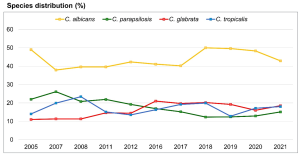
Review article Yong Jun Kwon, Jong Hee Shin Department of Laboratory Medicine, Chonnam National University Medical School, Gwangju, Korea Corresponding to Jong Hee Shin, E-mail: shinjh@chonnam.ac.kr Ann Clin Microbiol 2024;27(4):231-244. https://doi.org/10.5145/ACM.2024.27.4.3Received on 9 October 2024, Revised on 27 November 2024, Accepted on 29 November 2024, Published on 20 December 2024.Copyright © Korean Society of Clinical Microbiology.This is an Open Access article which is freely available under the Creative Commons Attribution-NonCommercial-NoDerivatives 4.0 International License (CC BY-NC-ND) (https://creativecommons.org/licenses/by-nc-nd/4.0/). Abstract Purpose: Candidemia is a common cause of nosocomial bloodstream infections associated with high mortality rates. Its incidence varies significantly across countries and hospitals, and its epidemiology is a subject of continuous investigation. This review aims to provide a comprehensive analysis of candidemia in Korea, addressing its changing epidemiology, species distribution, antifungal resistance, and clinical implications. Current content: In Korea, Candida albicans remains the most common isolate in blood cultures; however, infections caused by

Read More »

Four genotypes of carbapenem-resistant Acinetobacter baumannii strains lacking OXA-23 production in Korea

Brief communication Young Ah Kim1, Seok Hoon Jeong2,3, Jong Hee Shin4, Kyeong Seob Shin5, Jeong Hwan Shin6, Young Ree Kim7, Hyun Soo Kim8, Young Uh9, Nam Hee Ryoo10 1Department of Laboratory Medicine, National Health Insurance Service Ilsan Hospital, Goyang, 2Department of Laboratory Medicine, Yonsei University College of Medicine, Seoul, 3Research Institute of Bacterial Resistance, Yonsei University College of Medicine, Seoul, 4Department of Laboratory Medicine, Chonnam National University Medical School, Gwangju, 5Department of Laboratory Medicine, Chungbuk National University College of Medicine, Cheongju, 6Department of Laboratory Medicine and Paik Institute for Clinical Research, Inje University College of Medicine, Busan, 7Department of Laboratory Medicine, Jeju National University, College of Medicine, Jeju, 8Department of Laboratory Medicine, Hallym University Dongtan Sacred Heart Hospital, Hallym University College of Medicine, Hwaseong, 9Department of Laboratory Medicine, Yonsei University Wonju College of Medicine, Wonju, 10Department of Laboratory Medicine, Keimyung University School of Medicine, Daegu, Korea Corresponding to Young Ah

Read More »

Laboratory Diagnosis of Opportunistic Fungal Infections

Review article PDF Jong Hee Shin, M.D. Department of Clinical Pathology, Chonnam University Medical School, Kwangju, Korea Corresponding to Jong Hee Shin Ann Clin Microbiol 1998;1(1):37-43.Copyright © Korean Society of Clinical Microbiology. Abstract In the past decades there has been a dramatic increase in the number of opportunistic fungal infections. Establishing the diagnosis of opportunistic fungal infections in compromised patients is not simple. The laboratory diagnostic tests include microscopic examination, culture and serological tests. Although the most reliable method is the histologic examination, various opportunistic fungal agents can reveal similar histologic morphology. Culture should be attempted, however, the isolation of these organisms from cultures must be interpretated with caution, because the causing agents for opportunistic fungal infections are common laboratory contaminants. Serology for fungal infections has limited value except cryptococcal antigen: the usefulness of detection of antigenemia in invasive candidiasis and invasive aspergillosis has been limited by the rapid clearance

Read More »

A Case of Infective Endocarditis Caused by Haemophilus paraphrophilus

Case report PDF Myoung Youn, M.D., Jong Hee Shin, M.D., Soon Pal Suh, M.D. and Dong Wook Ryang, M.D. Department of Clinical Pathology, Chonnam University Medical School, Kwangju, Korea Corresponding to Jong Hee Shin, E-mail: shinjh@chonnam.chonnam.ac.kr Ann Clin Microbiol 1999;2(1):95-100.Copyright © Korean Society of Clinical Microbiology. Abstract Haemophilus paraphrophilus is a normal inhabitant of the naso- and oropharynx and has been rarely reported as a cause of endocarditis. H. paraphrophilus is a slow-growing and fastidious gram-negative bacterium and belongs to the HACEK group. We experienced a case of infective endocarditis due to H. paraphrophilus. The organism was repeatedly isolated from the blood cultures of a 60 year-old patient presenting with high fever, chills, cardiac murmur, and change of mental state. The patient had a history of mitral and tricuspid valve replacements and had been followed up for complications of cirrhosis of liver such as esophageal varix and oral bleeding. The isolate was identified as H.

Read More »

Clinical Characteristics of Pediatric Patients with Candidemia

Original article PDF Kung Ok Yoo, M.D.*, Sang Khoo Lee, M.D.***, Chang Jae Lee, M.D.*, Jong Hee Shin, M.D.*,**, Soon Pal Suh, M.D.*,** and Dong Wook Ryang, M.D.*,** Department of Clinical Pathology*, Chonnam National University Medical School, Research Institute of Medical Sciences**, Chonnam National University, Gwangju, Korea and Mokpo Catholic Hospital,*** Mokpo, Korea Corresponding to Jong Hee Shin, E-mail: shinjh@chonnam.ac.kr Ann Clin Microbiol 2001;4(2):122-128.Copyright © Korean Society of Clinical Microbiology. Abstract Background:The incidence of candidemia in paediatric patients has increased over the last decade. We analysed the clinical characteristics of pediatric patients with candidemia over a 3-year period in Chonnam National University Hospital. Methods:The medical records of 28 patients with candidemia diagnosed between 1996 and 1998 were retrospectively reviewed. Clinical characteristics including underlying illness, risk factors, therapy and outcome were assessed in relation to causing Candida species. Results:The causing agents were mainly non-C. albicans species (24/28 cases, 81.5%). Underlying illnesses

Read More »