Annals of Clinical Microbiology, The official Journal of the Korean Society of Clinical Microbiology

6

Weeks in Review

4

Weeks to Publication
Indexed in KCI, KoreaMed, Synapse, DOAJ
Open Access, Peer Reviewed
pISSN 2288-0585 eISSN 2288-6850

Search Results for: Young Ah Kim – Page 4

Molecular epidemiological characteristics of monophasic Salmonella enterica serovar Typhimurium variants in Korea

Original article Eun-Young Kim1,2 , Su Man Kim1,2 , Si Hyun Kim3 , Jeong Hwan Shin1,2 1Department of Laboratory Medicine, Inje University Busan Paik Hospital, Inje University College of Medicine, Busan, Korea2Paik Institute for Clinical Research, Inje University College of Medicine, Busan, Korea3Department of Biomedical Laboratory Science, Inje University, Gimhae, Korea Ann Clin Microbiol 2026;29(3):14. https://doi.org/10.5145/ACM.2026.29.3.14Received on 21 July 2026, Revised on 1 September 2026, Accepted on 10 September 2026, Published on 20 September 2026.Copyright © Korean Society of Clinical Microbiology.This is an Open Access article which is freely available under the Creative Commons Attribution-NonCommercial-NoDerivatives 4.0 International License (CC BY-NC-ND) (https://creativecommons.org/licenses/by-nc-nd/4.0/). Abstract Background: Monophasic Salmonella enterica serovar Typhimurium variants, particularly the serotype I 4,[5],12:i:-, have globally emerged as important foodborne pathogens associated with multidrug resistance. However, their molecular epidemiology and clonal distribution in South Korea remain unclear. This study investigated the distribution, clonal characteristics, and antimicrobial resistance profiles of S.
Read More »

Evolving molecular epidemiology and antimicrobial resistance of Streptococcus agalactiae in South Korea and East Asia: a narrative review

Review article Kwangjin Ahn , Young Uh Department of Laboratory Medicine, Wonju Severance Christian Hospital, Yonsei University Wonju College of Medicine, Wonju, Korea Ann Clin Microbiol 2026;29(3):12. https://doi.org/10.5145/ACM.2026.29.3.12Received on 24 June 2026, Revised on 20 July 2026, Accepted on 23 July 2026, Published on 16 September 2026.Copyright © Korean Society of Clinical Microbiology.This is an Open Access article which is freely available under the Creative Commons Attribution-NonCommercial-NoDerivatives 4.0 International License (CC BY-NC-ND) (https://creativecommons.org/licenses/by-nc-nd/4.0/). Abstract Streptococcus agalactiae (group B Streptococcus, GBS) remains a major pathogen in neonatal and adult invasive diseases, while maternal colonization continues to shape prevention strategies for early-onset disease. This narrative review examines how changes in capsular serotypes, sequence types (STs), clonal complexes (CCs), and antimicrobial resistance (AMR) determinants are reshaping the molecular epidemiology of GBS, with emphasis on South Korea and comparisons across East Asia. Conventional serotyping and multilocus sequence typing remain useful for lineage definition, whereas

Read More »

Laser scattering signal amplification and deep learning for detection of Candida culture positivity in women with vaginal symptoms: a preliminary analytical and pilot clinical evaluation

Original article Jeong Su Park1,*, Jehada-Inn Alihuddin2,*, Kidong Kim2,3, Kyoungman Cho4, Jung-A Shin1, Mulbora Jee2 1Department of Laboratory Medicine, Seoul National University Bundang Hospital, Seongnam, Korea2Department of Obstetrics and Gynecology, Seoul National University Bundang Hospital, Seongnam, Korea3Department of Obstetrics and Gynecology, Seoul National University College of Medicine, Seongnam, Korea4The Wavetalk Co., Ltd., Daejeon, Korea *These authors contributed equally as co-first authors. Correspondence to Kidong Kim E-mail: kidong.kim.md@gmail.com Ann Clin Microbiol 2026;29(2):9. https://doi.org/10.5145/ACM.2026.29.2.9Received on 13 April 2026, Revised on 29 May 2026, Accepted on 4 June 2026, Published on 20 June 2026.Copyright © Korean Society of Clinical Microbiology.This is an Open Access article which is freely available under the Creative Commons Attribution-NonCommercial-NoDerivatives 4.0 International License (CC BY-NC-ND) (https://creativecommons.org/licenses/by-nc-nd/4.0/). Abstract Background: Accurate diagnosis of vulvovaginal candidiasis (VVC) is challenging because of the limitations of conventional wet-mount microscopy, which requires a trained examiner and offers suboptimal sensitivity. This preliminary study evaluated the analytical

Read More »

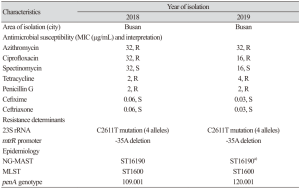
Whole-genome characterization of two azithromycin-resistant Neisseria gonorrhoeae ST1600 isolates from Busan, South Korea

Brief communication Changseung Liu1, Young Hee Seo2, Kyoung Ho Roh3, Hyukmin Lee2, Kyungwon Lee2,4 1Department of Laboratory Medicine, Gangneung Asan Hospital, University of Ulsan College of Medicine, Gangneung, Korea2Department of Laboratory Medicine and Research Institute of Bacterial Resistance, Yonsei University College of Medicine, Seoul, Korea3Department of Laboratory Medicine, National Health Insurance Service Ilsan Hospital, Goyang, Korea4Seoul Clinical Laboratories Academy, Yongin, Korea Correspondence to Kyoung Ho Roh E-mail: director.roh@gmail.com Ann Clin Microbiol 2026;29(2):8. https://doi.org/10.5145/ACM.2026.29.2.8Received on 10 April 2026, Revised on 27 May 2026, Accepted on 7 June 2026, Published on 20 June 2026.Copyright © Korean Society of Clinical Microbiology.This is an Open Access article which is freely available under the Creative Commons Attribution-NonCommercial-NoDerivatives 4.0 International License (CC BY-NC-ND) (https://creativecommons.org/licenses/by-nc-nd/4.0/). Abstract Azithromycin-resistant Neisseria gonorrhoeae poses a threat to the efficacy of gonorrhea treatment. We report the whole-genome characterization of two azithromycin-resistant N. gonorrhoeae ST1600 isolates collected in Busan, South Korea, in 2018

Read More »

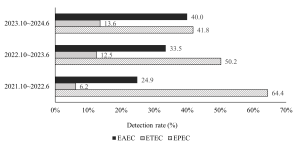
Antibiotic resistance patterns of pathogenic Escherichia coli isolated from southeastern Korean patients with acute diarrhea from October 2023 to June 2024: a cross-sectional surveillance study

Original article Suyeon Jo, Byoungkuk Kim, Boyeong Kwon, Kwanghyun Kim, Minhyeok Kim, Kihyung Park Department of Laboratory Medicine, Seegene Medical Foundation, Busan, Korea Correspondence to Suyeon Jo E-mail: freedom96@naver.com; Kihyung Park E-mail: p0413@mf.seegene.com Ann Clin Microbiol 2026;29(1):4. https://doi.org/10.5145/ACM.2026.29.1.4Received on 12 January 2026, Revised on 26 February 2026, Accepted on 27 February 2026, Published on 11 March 2026.Copyright © Korean Society of Clinical Microbiology.This is an Open Access article which is freely available under the Creative Commons Attribution-NonCommercial-NoDerivatives 4.0 International License (CC BY-NC-ND) (https://creativecommons.org/licenses/by-nc-nd/4.0/). Abstract Background: Pathogenic Escherichia coli (PEC) is a leading cause of acute diarrhea worldwide. With increasing antibiotic use, antimicrobial resistance in PEC has become a significant public health concern. In this study, we investigated the distribution and antimicrobial susceptibility patterns of PEC isolated from patients with acute diarrhea in the Busan and Gyeongnam regions of South Korea. Methods: In this retrospective cross-sectional laboratory-based study, 272 PCR-positive residual

Read More »

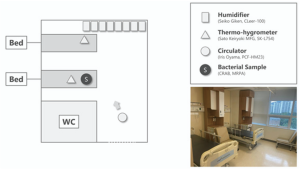
Bactericidal efficacy of atomized hypochlorous acid water against carbapenem-resistant Acinetobacter baumannii and multidrug-resistant Pseudomonas aeruginosa in a hospital room

Original article Jungmi Kim1, Inyoung Kang1, Sunjoo Kim1,2 1Institute of Medical Science, Gyeongsang National University, Jinju, Korea2Department of Laboratory Medicine, GC Labs, Yangsan, Korea Correspondence to Sunjoo Kim E-mail: sjkim8239@hanmail.net Ann Clin Microbiol 2026;29(1):3. https://doi.org/10.5145/ACM.2026.29.1.3Received on 8 January 2026, Revised on 4 February 2026, Accepted on 18 February 2026, Published on 9 March 2026.Copyright © Korean Society of Clinical Microbiology.This is an Open Access article which is freely available under the Creative Commons Attribution-NonCommercial-NoDerivatives 4.0 International License (CC BY-NC-ND) (https://creativecommons.org/licenses/by-nc-nd/4.0/). Abstract Background: Environmental contamination with multidrug-resistant organisms (MDROs), including carbapenem-resistant Acinetobacter baumannii (CRAB) and multidrug-resistant Pseudomonas aeruginosa (MRPA), remains a major challenge in healthcare facilities. Hypochlorous acid water (HOCl) has emerged as a promising disinfectant owing to its strong antimicrobial activity and favorable safety profile. This study aimed to evaluate the bactericidal efficacy of atomized HOCl against CRAB and MRPA in a hospital room. Methods: An atomization experiment was conducted

Read More »

Whole-genome sequencing as the new framework of clinical microbiology and highlights in this issue

Editorial Hae-Sun Chung Department of Laboratory Medicine, Ewha Womans University College of Medicine, Seoul, Korea Correspondence to Hae-Sun Chung, E-mail: sunny0521.chung@ewha.ac.kr Ann Clin Microbiol 2025;28(4):27. https://doi.org/10.5145/ACM.2025.28.4.8Received on 16 December 2025, Revised on 18 December 2025, Accepted on 18 December 2025, Published on 20 December 2025.Copyright © Korean Society of Clinical Microbiology.This is an Open Access article which is freely available under the Creative Commons Attribution-NonCommercial-NoDerivatives 4.0 International License (CC BY-NC-ND) (https://creativecommons.org/licenses/by-nc-nd/4.0/). The expanding role of whole-genome sequencing in clinical microbiology: A specially invited review Infectious diseases remain a leading cause of morbidity and mortality worldwide, and antimicrobial resistance (AMR) continues to erode the effectiveness of standard treatment pathways. Against this backdrop, whole-genome sequencing (WGS) has shifted from being a specialized research capability to a practical engine for clinical decision support, outbreak investigation, and pathogen surveillance. The review by the distinguished Japanese scholar Professor Takashi Takahashi [1], “Whole-genome sequencing applications for

Read More »

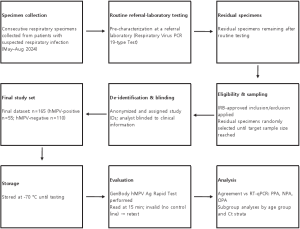
Clinical evaluation of GenBody hMPV Ag Rapid Test: a diagnostic accuracy study

Original article Sungwook Song, Eunsim Shin, Sunghee Han, Sang Gon Lee Laboratory Medicine Center, Division of Laboratory Medicine, GC Labs, Yongin, Korea Correspondence to Sungwook Song, E-mail: song1221@gclabs.co.kr Ann Clin Microbiol 2025;28(4):25. https://doi.org/10.5145/ACM.2025.28.4.6Received on 26 September 2025, Revised on 9 December 2025, Accepted on 10 December 2025, Published on 20 December 2025.Copyright © Korean Society of Clinical Microbiology.This is an Open Access article which is freely available under the Creative Commons Attribution-NonCommercial-NoDerivatives 4.0 International License (CC BY-NC-ND) (https://creativecommons.org/licenses/by-nc-nd/4.0/). Abstract Background: Human metapneumovirus (hMPV) is a major cause of acute respiratory infections in children and adults worldwide; however, no antiviral therapies or vaccines are currently available. Therefore, rapid and reliable diagnostic tools are required to support timely patient management and control outbreaks. Methods: We retrospectively evaluated GenBody hMPV Ag Rapid Test results using 165 consecutive clinical samples collected from patients with suspected respiratory infections between May and August 2024. Specimens were

Read More »

Drug susceptibility testing of Mycobacterium avium complex using the SLOMYCO test-system: a diagnostic accuracy study

Original article Jeong Su Park1*, Kyu-Hwa Hur2*, Woo Jin Shin1, Hyunji Kim1, Dong Woo Shin1, Kyoung Un Park1 1Department of Laboratory Medicine, Seoul National University Bundang Hospital, Seoul National University College of Medicine, Seongnam, Korea2Department of Laboratory Medicine, Green Cross Laboratories, Yongin, Korea*These authors contributed equally to this work. Correspondence to Jeong Su Park, E-mail: mdmicrobe@gmail.com Ann Clin Microbiol 2025;28(4):24. https://doi.org/10.5145/ACM.2025.28.4.5Received on 12 November 2025, Revised on 10 December 2025, Accepted on 10 December 2025, Published on 20 December 2025.Copyright © Korean Society of Clinical Microbiology.This is an Open Access article which is freely available under the Creative Commons Attribution-NonCommercial-NoDerivatives 4.0 International License (CC BY-NC-ND) (https://creativecommons.org/licenses/by-nc-nd/4.0/). Abstract Background: Mycobacterium avium complex (MAC) is a major cause of pulmonary nontuberculous mycobacterial disease; however, treatment outcomes remain suboptimal. Phenotypic drug susceptibility testing (DST) is conditionally recommended; however, conventional broth microdilution is labor-intensive. The Sensititre SLOMYCO® panel offers a standardized platform for DST

Read More »

Principles and clinical applications of interferon-gamma release assays in latent tuberculosis diagnosis

Review article Ha-eun Cho1, Young Jin Kim2 1Department of Laboratory Medicine, Kyung Hee University Hospital, Seoul, Korea2Department of Laboratory Medicine, Kyung Hee University College of Medicine, Kyung Hee University Hospital, Seoul, Korea Correspondence to Young Jin Kim, E-mail: khmclab@gmail.com Ann Clin Microbiol 2025;28(3):17. https://doi.org/10.5145/ACM.2025.28.3.6Received on 7 July 2025, Revised on 4 September 2025, Accepted on 4 September 2025, Published on 20 September 2025.Copyright © Korean Society of Clinical Microbiology.This is an Open Access article which is freely available under the Creative Commons Attribution-NonCommercial-NoDerivatives 4.0 International License (CC BY-NC-ND) (https://creativecommons.org/licenses/by-nc-nd/4.0/). Abstract Latent tuberculosis infection refers to a state in which an individual is infected with Mycobacterium tuberculosis but shows no clinical symptoms. The World Health Organization estimates that 23-25% of the global population has LTBI, which poses a significant public health challenge owing to the risk of progression to active TB. Diagnosis of LTBI involves tests, such as the tuberculin skin test

Read More »