
Annals of Clinical Microbiology, The official Journal of the Korean Society of Clinical Microbiology

6

Weeks in Review

4

Weeks to Publication
Indexed in KCI, KoreaMed, Synapse, DOAJ
Open Access, Peer Reviewed
pISSN 2288-0585 eISSN 2288-6850
Review article

Drug susceptibility testing for Mycobacterium tuberculosis: a narrative review

Department of Laboratory Medicine, Seoul Clinical Laboratories, Yongin, Korea

Correspondence to Chang-Ki Kim, E-mail: psoas95@gmail.com

Ann Clin Microbiol 2025;28(4):26. https://doi.org/10.5145/ACM.2025.28.4.7
Received on 7 December 2025, Revised on 14 December 2025, Accepted on 15 December 2025, Published on 20 December 2025.
Copyright © Korean Society of Clinical Microbiology.
This is an Open Access article which is freely available under the Creative Commons Attribution-NonCommercial-NoDerivatives 4.0 International License (CC BY-NC-ND) (https://creativecommons.org/licenses/by-nc-nd/4.0/).

Abstract

Tuberculosis (TB) remains a major global health threat, and the emergence and spread of drug-resistant Mycobacterium tuberculosis continue to undermine control efforts. Multidrug-resistant and rifampicin-resistant TB (MDR/RR-TB) is associated with prolonged treatment, higher toxicity, increased costs, and poorer outcomes compared to susceptible TB, making rapid and accurate drug susceptibility testing (DST) essential for effective patient management and transmission prevention. This review summarizes the current methods for DST in TB, focusing on the principles, strengths, and limitations of phenotypic and molecular approaches. Phenotypic DST, including the proportion, absolute concentration, and resistance ratio methods, and automated liquid culture systems, remains the conventional reference standard; however, conventional methods are limited by long turnaround times and technical complexity for certain drugs (such as pyrazinamide). Molecular DST targets resistance-associated mutations in key genes and is represented by line probe assays and cartridge-based platforms such as the Xpert MTB/RIF, which provide rapid results but are restricted to predefined genetic loci and may exhibit discordance with phenotypic DST, particularly with regard to borderline resistance. Next-generation sequencing (NGS)-based assays, including whole-genome sequencing and targeted NGS panels, offer comprehensive resistance profiling with high diagnostic accuracy and are increasingly being incorporated into international guidelines. Finally, we discuss the clinical interpretation of discordant results between genotypic and phenotypic DST, the impact of revised rifampicin critical concentrations, and the integration of DST results into contemporary World Health Organization guidelines and Korean treatment recommendations for MDR/RR-TB. Informed, methodologically grounded use of DST is crucial for optimizing the diagnosis and management of drug-resistant TB.

Keywords

Mycobacterium tuberculosis, Microbial sensitivity tests, Multidrug-resistant tuberculosis, Next generation sequencing

Introduction

Tuberculosis (TB) remains one of the most notable threats to global health, and millions of people continue to suffer from it. According to the World Health Organization (WHO), an estimated 10.7 million TB cases and 1.23 million TB-related deaths occurred in 2024 [1]. The emergence and spread of drug-resistant TB are major obstacles to global TB control [1]. Drug resistance not only compromises the effectiveness of standard regimens, but also leads to prolonged treatment, increased toxicity, higher costs, and worse clinical outcomes than susceptible TB [2]. Therefore, the rapid and accurate detection of drug resistance is essential for optimizing patient management, preventing transmission, and improving treatment outcomes [2].

In this review, we summarize the current methods for drug susceptibility testing (DST), including the key principles of phenotypic testing, molecular assays, and emerging next-generation sequencing (NGS) technologies. We also highlight the causes and implications of the discordant results between genotypic and phenotypic DST (pDST) and discuss how recent WHO guidelines incorporate these diagnostic advances into the management of drug-resistant TB.

Anti-TB drug resistance and treatment

Drug resistance in Mycobacterium tuberculosis primarily arises from spontaneous chromosomal mutations, which occur at a low frequency, typically ranging between 10⁻⁴–10⁻⁸ per bacterium per generation, depending on the drug [3]. When patients receive inappropriate regimens or demonstrate poor treatment adherence, susceptible bacterial populations are progressively eliminated under selective pressure, allowing the expansion of resistant subpopulations [2,3]. The resistance that emerges as a result of this process is referred to as acquired resistance. In contrast, resistance resulting from infection with drug-resistant strains is termed primary resistance. From an epidemiological standpoint, drug resistance is often classified according to treatment history: new cases, defined as patients with no prior TB treatment or less than one month of previous therapy; and previously treated cases, defined as individuals who have received anti-TB drugs for one month or longer. The standard categories of drug-resistant TB based on resistance patterns are summarized in Table 1.


Table 1. Drug-resistant tuberculosis classifications

Drug-resistanceDescription
Isoniazid-resistant TB (rifampicin-susceptible) (Hr-TB)Tuberculosis caused by Mycobacterium tuberculosis strains that are resistant to isoniazid but remain susceptible to rifampicin.
Rifampicin-resistant TB (RR-TB)TB caused by strains resistant to rifampicin, with or without resistance to other first-line drugs.
Multidrug-resistant TB (MDR-TB)TB caused by strains resistant to at least both isoniazid and rifampicin.
Pre-extensively drug-resistant TB (pre-XDR-TB)RR-TB or MDR-TB with additional resistance to any fluoroquinolone.
Extensively drug-resistant TB (XDR-TB)RR-TB or MDR-TB with additional resistance to any fluoroquinolone and at least one Group A agent (e.g., bedaquiline or linezolid).

Abbreviation: TB, tuberculosis.

DST for M. tuberculosis is broadly categorized into phenotypic and molecular DST (mDST) [4]. Both the WHO and Korean guidelines for TB recommend the combined use of these two approaches, as they provide complementary information [4,5]. The primary objective of DST is early detection of multidrug-resistant TB (MDR-TB). Accordingly, susceptibility to both isoniazid (INH) and rifampicin (RIF) should be assessed using phenotypic and molecular methods. Once resistance to INH and RIF is confirmed, determining fluoroquinolone (FQ) resistance is crucial for selecting an appropriate treatment regimen [4,5]. As most RIF-resistant strains are also resistant to INH and RIF-resistant TB is managed similarly to MDR-TB, RIF resistance serves as a reliable surrogate marker for MDR-TB. Therefore, the current WHO and domestic guidelines classify MDR-TB and RIF-resistant TB (RR-TB) within the same clinical category [1,4].

According to WHO estimates, the global prevalence of MDR/RR-TB in 2024 was 3.2% and 16% among new and previously treated patients, respectively [4]. Historically, the highest resistance rates have been reported in countries in the former Soviet Union, where more than half of the previously treated cases were MDR/RR-TB [1]. In Korea, comprehensive nationwide surveillance data on drug resistance remain limited because routine population-based surveys have not been conducted. Based on the national TB notification data, the proportion of MDR/RR-TB cases in 2022 was 3% among new cases and 8.4% among previously treated cases.

The standard regimen for drug-susceptible TB (2HRZE/4HR) consists of an initial intensive phase with INH, RIF, ethambutol, and pyrazinamide (PZA) for two months, followed by a four-month maintenance phase with INH and RIF [6]. Historically, the treatment of INH-monoresistant TB (Hr-TB) involved the extension of first-line therapy. However, because Hr-TB treated with only first-line drugs is associated with a high risk of relapse, treatment failure, and acquired resistance, FQs are now recommended as part of the treatment regimen [7,8]. The Korean guidelines for TB (fifth edition) classify the drugs used for the treatment of MDR/RR-TB into Groups A, B, and C (Table 2) [5]. The regimens prioritize Group A agents f irst, followed by Group B or C drugs, as needed. Unlike the WHO classification, the Korean guidelines categorize delamanid as a Group A agent.

Table 2. Classification of drugs used in multidrug- and rifampicin-resistant tuberculosis treatment regimens in Korea [5]

GroupAnti-TB drug
ALevofloxacin or Moxifloxacin
Bedaquiline
Delamanid
Linezolid
BCycloserine
Clofazimine
CAmikacin or Kanamycin (Streptomycin)
Ethambutol
Imipenem-cilastatin or Meropenem
Para-aminosalicylc acid (PAS)
Prothionamide
Pyrazinamide

Group A: Highly effective core medicines that should be included in all longer MDR/RR-TB regimens unless contraindicated due to toxicity, intolerance, or known resistance; Group B: Companion medicines selected after Group A agents when constructing long regimens; Group C: Additional medicines that may be incorporated when an adequate regimen cannot be composed of Group A or B agents alone.
Abbreviation: TB, tuberculosis; MDR/RR-TB, multidrug-resistant/rifampicin-resistant TB.

In alignment with the updated WHO recommendations, Korean guidelines endorse shorter clinically validated regimens for MDR/RR-TB. FQ susceptibility testing is essential for patients with confirmed MDR/ RR-TB [5]. If the strain is FQ-susceptible, recommended regimens include a six-month BPaLM regimen (bedaquiline, pretomanid, linezolid, and moxifloxacin) or nine-month MDR-END regimen (levofloxacin, delamanid, linezolid, and PZA) [9,10]. If the strain is FQ-resistant, a six-month BPaL regimen (bedaquiline, pretomanid, and linezolid) is recommended [11]. For patients who are not eligible for short-course regimens due to clinical or microbiological considerations, long, individualized regimens should be used [5].

pDST

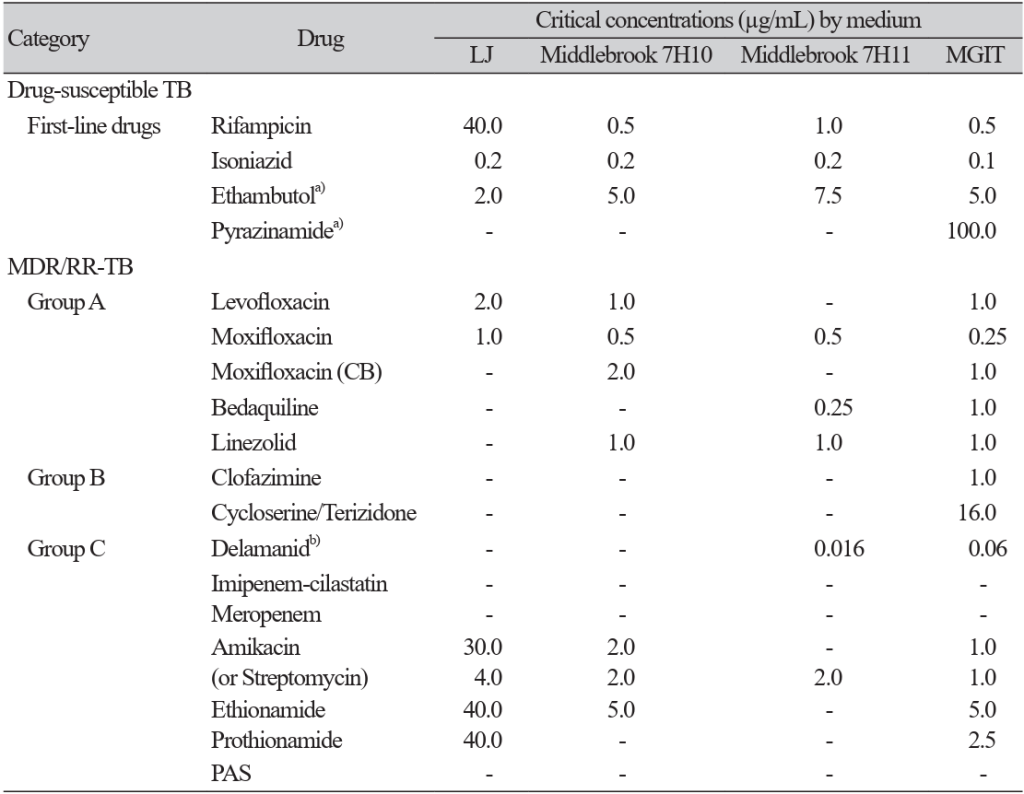
The pDST, also referred to as the conventional DST, encompasses culture-based methods used to assess the susceptibility of M. tuberculosis to anti-TB drugs. Conventional pDST include the absolute concentration method, resistance ratio method, proportion method, and assays performed using automated liquid culture systems [12]. Testing must be performed according to the critical concentrations recommended by WHO, which vary depending on the assay platform and culture medium (Table 3) [4,13]. The critical concentration is defined as the lowest drug concentration that inhibits 99% of phenotypically wild-type isolates of the M. tuberculosis complex in vitro [14].

Table 3. Critical concentrations of drugs recommended for treating drug-susceptible and multidrug- or rifampicin-resistant tuberculosis

CategoryDrugCritical concentrations (μg/mL) by medium
LJMiddlebrook 7H10Middlebrook 7H11MGIT
Drug-susceptible TB
  First-line drugsRifampicin40.00.51.00.5
Isoniazid0.20.20.20.1
Ethambutola)2.05.07.55.0
Pyrazinamidea)100.0
MDR/RR-TB
  Group ALevofloxacin2.01.01.0
Moxifloxacin1.00.50.50.25
Moxifloxacin (CB)2.01.0
Bedaquiline0.251.0
Linezolid1.01.01.0
  Group BClofazimine1.0
Cycloserine/Terizidone16.0
  Group CDelamanidb)0.0160.06
Imipenem-cilastatin
Meropenem
Amikacin30.02.01.0
(or Streptomycin)4.02.02.01.0
Ethionamide40.05.05.0
Prothionamide40.02.5
PAS

a)Ethambutol and pyrazinamide are also classified as Group C agents for MDR/RR-TB regimens according to the World Health Organization (WHO) guidelines; b)Although delamanid is categorized as a Group C drug according to the WHO guidelines, it is classified as a Group A agent in the Korean guidelines for TB.
Abbreviations: LJ, Löwenstein-Jensen; MGIT, mycobacterial growth indicator tube; TB, tuberculosis; MDR/RRTB, multidrug-resistant/rifampicin-resistant TB; CB, critical breakpoint concentration; PAS, para-aminosalicylic acid.

The proportion method, which is regarded as the standard method, involves preparing a bacterial suspension adjusted to a McFarland No. 1 standard and subsequently diluting it to 10⁻² and 10⁻⁴. These suspensions are inoculated into drug-free control media and media containing the drug. When the control medium yields 50–150 colonies, results can be interpreted: growth on drug-containing media ≥ 1% of the control colony count indicates resistance. This method is robust and minimally influenced by the inoculum size.

In the absolute concentration method, test strains are inoculated onto drug-free and drug-containing media, and their growth is compared directly. Because the results depend heavily on the initial inoculum, precise standardization of the inoculum density is essential. This method can be performed on Löwenstein–Jensen media, agar media, or broth microdilution systems. Several commercial kits allow the determination of the minimum inhibitory concentration (MIC) of both first- and second-line agents using microdilution formats.

The resistance ratio method determines the resistance by comparing the MIC of the test isolate with that of the standard M. tuberculosis strain H37Rv (ATCC 27294). Two sets of media containing serial dilutions of the anti-TB drugs are inoculated with the test and reference strains. Resistance ratio is defined as the MIC of the test strain divided by that of the reference strain. Ratios ≤ 2 indicate susceptibility; a ratio of 4 is considered borderline and warrants repeat testing; and ratios ≥ 8 indicate resistance. Similar to the absolute concentration method, the results may be affected by variations in inoculum size.

Automated liquid culture systems, such as BACTEC Mycobacteria Growth Indicator Tube (MGIT) 960, are being increasingly used in clinical laboratories. Although their operating principles are similar to those of the proportion method, these systems offer fast turnaround times and standardized workflows. Commercial kits (e.g., MGIT streptomycin, INH, RIF, and ethambutol [SIRE] kit) are available for first-line drugs, and critical concentrations have also been established for selected second-line agents [13,15].

PZA requires an acidic environment, making standard media unsuitable for testing. Solid media are not appropriate for PZA testing as M. tuberculosis does not grow sufficiently under acidic conditions to permit PZA activity. The BACTEC MGIT 960 PZA kit provides an acidified liquid medium and is commercially available; however, its incubation period is relatively long (up to three weeks). Alternative methods include testing for pyrazinamidase (PZAase) activity, which converts PZA into pyrazinoic acid and ammonia [16,17]. The loss of PZAase activity is strongly correlated with PZA resistance. The molecular detection of mutations in pncA, the gene encoding PZAase, is a valuable approach for predicting PZA resistance [18].

mDST

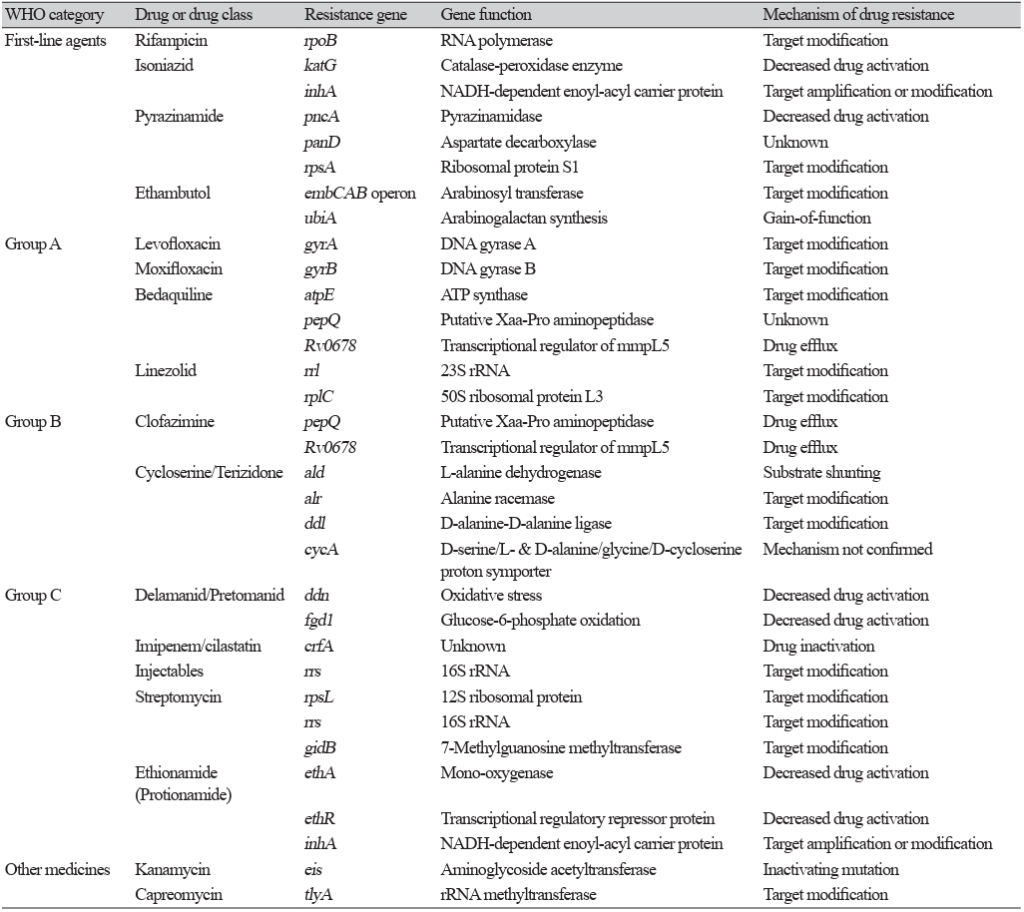
Mutations in genes associated with the targets or activation pathways of anti-TB drugs confer resistance in M. tuberculosis [2,19,20]. The major resistance-associated genes and mechanisms of action of each drug are summarized in Table 4 [20]. The primary target of RIF, a critical first-line agent, is the β-subunit of DNAdependent RNA polymerase. rpoB mutations have also been detected in the vast majority of RIF-resistant strains. INH is a prodrug activated by the catalase–peroxidase enzyme, encoded by katG. katG mutations are the most common cause of INH resistance. Additional inhA, kasA, and ahpC mutations also contribute to INH resistance development. Based on these well-established genetic determinants, rapid molecular tests have been commercialized and widely adopted for RIF and INH resistance detection [4]. These assays can be performed directly on smear-positive clinical specimens or cultured isolates, offering a markedly shorter turnaround time than conventional pDST.

Table 4. Functions of resistance-associated genes and drug resistance mechanisms in Mycobacterium tuberculosis [20]

WHO categoryDrug or drug classResistance geneGene functionMechanism of drug resistance
First-line agentsRifampicinrpoBRNA polymeraseTarget modification
IsoniazidkatGCatalase-peroxidase enzymeDecreased drug activation
inhANADH-dependent enoyl-acyl carrier proteinTarget amplification or modification
PyrazinamidepncAPyrazinamidaseDecreased drug activation
panDAspartate decarboxylaseUnknown
rpsARibosomal protein S1Target modification
EthambutolembCAB operonArabinosyl transferaseTarget modification
ubiAArabinogalactan synthesisGain-of-function
Group ALevofloxacingyrADNA gyrase ATarget modification
MoxifloxacingyrBDNA gyrase BTarget modification
BedaquilineatpEATP synthaseTarget modification
pepQPutative Xaa-Pro aminopeptidaseUnknown
Rv0678Transcriptional regulator of mmpL5Drug efflux
Linezolidrrl23S rRNATarget modification
rplC50S ribosomal protein L3Target modification
Group BClofaziminepepQPutative Xaa-Pro aminopeptidaseDrug efflux
Rv0678Transcriptional regulator of mmpL5Drug efflux
Cycloserine/TerizidonealdL-alanine dehydrogenaseSubstrate shunting
alrAlanine racemaseTarget modification
ddlD-alanine-D-alanine ligaseTarget modification
cycAD-serine/L- & D-alanine/glycine/D-cycloserine proton symporterMechanism not confirmed
Group CDelamanid/PretomanidddnOxidative stressDecreased drug activation
fgd1Glucose-6-phosphate oxidationDecreased drug activation
Imipenem/cilastatincrfAUnknownDrug inactivation
Injectablesrrs16S rRNATarget modification
StreptomycinrpsL12S ribosomal proteinTarget modification
rrs16S rRNATarget modification
gidB7-Methylguanosine methyltransferaseTarget modification
Ethionamide (Prothionamide)ethAMono-oxygenaseDecreased drug activation
ethRTranscriptional regulatory repressor proteinDecreased drug activation
inhANADH-dependent enoyl-acyl carrier proteinTarget amplification or modification
Other medicinesKanamycineisAminoglycoside acetyltransferaseInactivating mutation
CapreomycintlyArRNA methyltransferaseTarget modification

Abbreviations: WHO, World Health Organization; NADH, nicotinamide adenine dinucleotide (reduced form); ATP, adenosine triphosphate.

1. Line probe assays (LPAs)

LPAs are the most widely used rapid molecular tests for drug resistance detection in M. tuberculosis [21]. The GenoType® MTBDRplus assay (Hain Lifescience) identifies mutations in rpoB, katG, and the inhA promoter region, enabling simultaneous RIF and INH resistance detection. The reported sensitivities were 98.4% for RIF resistance and 88.7% for INH resistance, with specificities of 98.9% and 99.2%, respectively [21]. Other LPAs capable of MDR-TB detection include MolecuTech REBA MTB-MDR (YD Diagnostics), INNO-LiPA Rif.TB (Fujirebio), and AdvanSure MDR-TB GenoBlot (Invitros) [2224]. Although these assays differ in technical features, their underlying principles are similar. To detect RIF resistance, LPAs amplify the RIF resistance-determining region of the rpoB gene and hybridize the product with wild-type and mutation-specific probes. Loss of hybridization to any wild-type probe or binding to a mutated probe indicates resistance [23]. LPAs capable of detecting resistance to additional drug classes are also available, including GenoType MTBDRsl (Hain Lifescience), GENOSCHOLAR™ FQ+KM-TB II (Nipro), and GENOSCHOLAR™ PZA-TB II (Nipro) [4]. However, LPAs require multiple manual steps after polymerase chain reaction (PCR) amplification, complicating the workflow and making it time-consuming. Moreover, the sensitivity of such LPAs is suboptimal for smear-negative samples; therefore, LPAs are generally restricted to smear-positive specimens or cultured isolates.

2. Xpert MTB/RIF

The Xpert MTB/RIF (Xpert) assay is an automated cartridge-based molecular test that simultaneously detects M. tuberculosis and RIF resistance using real-time PCR, targeting the rpoB gene using molecular beacon probes [25]. The WHO recommends Xpert as the first-line diagnostic test for individuals with suspected pulmonary or extrapulmonary TB. According to a systematic review, this assay demonstrated a sensitivity of 67% for smear-negative/culture-positive specimens and 98% for smear-positive/culture-positive specimens, with a pooled specificity of approximately 98% [25].

The new Xpert MTB/RIF Ultra (Xpert Ultra) was developed to enhance diagnostic sensitivity by amplifying two multicopy insertion sequences (IS6110 and IS1081) [2628]. This dual-target strategy markedly improves the detection of paucibacillary disease, although it is accompanied by a slight reduction in specificity, particularly among patients with a history of TB. Xpert Ultra has also introduced a “trace” category, indicating low levels of M. tuberculosis DNA [29]. Interpretation of the trace results can be challenging. However, current recommendations suggest that, in patients without prior TB and with compatible clinical or radiological features, a trace result may be interpreted as indicative of TB [4]. Clinical correlation remains essential when incorporating Xpert Ultra in diagnostic decision-making.

3. NGS

Conventional molecular tests are limited by the number of genes and mutations identified. Because TB drug resistance arises from a broad spectrum of chromosomal mutations, these targeted assays cannot fully capture the complexity of the resistance profiles. In addition, the ongoing identification of resistance mechanisms and introduction of novel anti-TB agents further complicate DST. This has increased interest in NGS as a comprehensive approach for drug resistance detection.

NGS-based testing for TB drug resistance involves two major strategies, whole-genome sequencing (WGS) and targeted NGS (tNGS) [30]. Theoretically, WGS provides the most comprehensive analysis because it examines the entire genome, offering information on resistance-associated mutations, phylogeny, transmission clusters, and other genomic features [20,30]. However, performing WGS directly on clinical specimens is complicated. It generates large datasets requiring extensive analysis, and it is relatively expensive [30]. In contrast, tNGS amplifies selected resistance-associated regions prior to sequencing, enabling high analytical sensitivity and direct application to clinical samples [4,30]. tNGS offers a lower cost, shorter turnaround time, and improved feasibility in routine diagnostic settings than WGS. Reflecting these advantages, the WHO included recommendations for targeted NGS in its 2024 updated guidelines [4]. Commercially available targeted NGS assays include: Deeplex® Myc-TB (Genoscreen), AmPORE-TB® (Oxford Nanopore Diagnostics), and TBseq® (Hangzhou ShengTing Medical Technology Co.) [4].

Recent evidence demonstrates that tNGS has a high overall diagnostic accuracy, with a pooled sensitivity of 94% and specificity of 98% for all drugs [31]. Sensitivity varied by agent, ranging from ~77% for capreomycin to > 99% for RIF, while specificity ranged from ~93% for ethambutol to > 99% for amikacin [31]. Notably, tNGS showed comparable diagnostic performance for detecting resistance to RIF, INH, ethambutol, streptomycin, and FQs when performed on primary clinical specimens and culture isolates [31].

Discordant results between mDST and pDST

 As mDST and pDST detect resistance through fundamentally different mechanisms, discordant results are inevitable. When the Xpert was first introduced, concerns were raised regarding possible “false-positives” for RIF resistance, and pDST results were often used as the reference standard. However, subsequent studies have demonstrated that discrepancies reflect structural differences between genotypic and phenotypic assays rather than test errors [3236].

A common pattern involves isolates identified as RIF-resistant by Xpert but susceptible by pDST [14, 3537]. Sequence analyses revealed specific mutations responsible for these mismatches. Molecular assays, such as Xpert, infer resistance from the presence of mutations, but certain mutations confer only low-level resistance, resulting in phenotypically susceptible results at standard critical concentrations. These mutations have been referred to as discordant, low-level resistance, or disputed mutations; however, the WHO now recommends the term borderline resistance mutations [14]. Seven RIF borderline resistance mutations have been identified (L430P, D435Y, H445L, H445S, H445N, L452P, and I491F), which collectively account for approximately 12% of all RIF-resistant isolates [14]. Although the MICs for isolates with borderline mutations may fall near or slightly below the traditional critical concentration, treatment outcomes with firstline regimens containing RIF resemble those observed in typical RIF-resistant TB [37]. Therefore, the WHO recommends that RIF resistance due to borderline mutations should be managed as MDR/RR-TB [4]. In addition, to improve detection of these mutations, WHO recently lowered the critical concentration for RIF in Middlebrook 7H10 and MGIT systems from 1.0 μg/mL to 0.5 μg/mL [4,14]. According to a recent study conducted in Korea, applying the revised critical concentration of RIF to Middlebrook 7H10 resulted in an approximately 10% increase in the RIF resistance [38]. In contrast, another study that applied the revised critical concentration for RIF using the MGIT system reported little change in RIF resistance [15].

Recent evidence indicates that the risk of false-positive RIF resistance in Xpert assays increases substantially in paucibacillary TB [3941]. In patients whose sputum samples yield a low M. tuberculosis burden on Xpert MTB/RIF or Xpert MTB/RIF Ultra, the positive predictive value for RIF resistance declines markedly, and recent studies have demonstrated that 80%–90% of such initial resistance calls may be reclassified as susceptible upon repeat testing with pDST or rpoB sequencing [39,40]. These findings suggest that a low bacillary load is a major driver of discordance between molecular and phenotypic results, most likely due to amplification bias and probe hybridization instability when the target DNA is present at extremely low concentrations. Therefore, molecular detection of RIF resistance in samples categorized as having a low M. tuberculosis load should not be interpreted as definitive evidence of resistance. Under such circumstances, confirmatory testing is recommended to avoid the unnecessary initiation of MDR-TB treatment [40].

In addition to RIF, molecular assays generally show a lower sensitivity than pDST for many other drugs. Resistance mechanisms often involve multiple genes and the full spectrum of resistance-associated mutations for several drugs remains unclear. Although several genes contribute to INH resistance, most commercial rapid tests detect mutations only in katG and the inhA promoter, resulting in a lower sensitivity than RIF resistance detection [21]. Similar limitations apply to molecular assays of other anti-TB drugs. Therefore, mDST result interpretation should incorporate the clinical context, including prior treatment history, known exposure to drug-resistant TB, and local epidemiology.

Conclusion

Accurate and timely detection of drug resistance is fundamental for effective TB control and remains a major determinant of treatment success. Although pDST is regarded as the conventional reference standard, it remains constrained by a prolonged turnaround time. Molecular diagnostic assays have substantially improved the speed of resistance detection; however, their performance is inherently limited by the range of mutations that they can target. NGS offers a comprehensive framework for characterizing resistance mechanisms and is increasingly being integrated into global diagnostic strategies.

Since molecular and phenotypic methods investigate fundamentally different biological processes, discordant results are inevitable. Careful interpretation of such discrepancies is essential, particularly when low or borderline resistance mutations are present. A thorough understanding of the strengths and limitations of pDST and mDST is, therefore, critical for their appropriate clinical application and to ensure accurate, patient-centered management of drug-resistant TB.


Ethics statement

This was not a human population study. Therefore, institutional review board approval and informed consent were not required.

Conflicts of interest

No potential conflicts of interest relevant to this article were reported.

Funding

None.

Data availability

This review article does not involve the generation or analysis of new datasets.

References

1. WHO. Global tuberculosis report 2025. Geneva: World Health Organization; 2025.

2. Pontali E, Matteelli A, Migliori GB. Drug-resistant tuberculosis. Curr Opin Pulm Med 2013;19:266-72.

3. Zhang Y and Yew WW. Mechanisms of drug resistance in Mycobacterium tuberculosis: update 2015. Int J Tuberc Lung Dis 2015;19:1276-89.

4. WHO. WHO consolidated guidelines on tuberculosis. Module 3: diagnosis. Geneva: World Health Organization; 2025.

5. KDCA. Korean guidelines for tuberculosis. 5th ed. Seoul: Korean Disease Control and Prevention Agency; 2025.

6. Nunn A, Phillips PPJ, Abubakar I. Treatment of pulmonary tuberculosis. Curr Opin Pulm Med 2013;19:273-9.

7. Jhun BW and Koh WJ. Treatment of isoniazid-resistant pulmonary tuberculosis. Tuberc Respir Dis 2020;83:20-30.

8. Kim YH, Suh GY, Chung MP, Kim H, Kwon OJ, Lim SY, et al. Treatment of isoniazid-resistant pulmonary tuberculosis. BMC Infect Dis 2008;8:6.

9. Nyang’wa BT, Berry C, Kazounis E, Motta I, Parpieva N, Tigay Z, et al. A 24-week, all-oral regimen for rifampin-resistant tuberculosis. N Engl J Med 2022;387:2331-43.

10. Mok J, Lee M, Kim DK, Kim JS, Jhun BW, Jo KW, et al. 9 months of delamanid, linezolid, levofloxacin, and pyrazinamide versus conventional therapy for treatment of fluoroquinolone-sensitive multidrug-resistant tuberculosis (MDR-END): a multicentre, randomised, open-label phase 2/3 non-inferiority trial in South Korea. Lancet 2022;400:1522-30.

11. Conradie F, Bagdasaryan TR, Borisov S, Howell P, Mikiashvili L, Ngubane N, et al. Bedaquiline-pretomanid-linezolid regimens for drug-resistant tuberculosis. N Engl J Med 2022;387:810-23.

12. Kim SJ. Drug-susceptibility testing in tuberculosis: methods and reliability of results. Eur Respir J 2005;25:564-9.

13. Wu X, Shang Y, Ren W, Wang W, Wang Y, Xue Z, et al. Minimum inhibitory concentration of cycloserine against Mycobacterium tuberculosis using the MGIT 960 system and a proposed critical concentration. Int J Infect Dis 2022;121:148-51.

14. WHO. Technical report on critical concentrations for drug susceptibility testing of isoniazid and the rifamycins (rifampicin, rifabutin and rifapentine). Geneva: World Health Organization; 2021.

15. Yu HJ, Kim TY, Kim G, Shim HJ, Kang OK, Kim S, et al. Performance evaluation of the BACTEC MGIT 960 system for rifampin drug-susceptibility testing of Mycobacterium tuberculosis using the current WHO critical concentration. J Clin Microbiol 2023;61:e01086-22.

16. Chan HH, Wang YC, Jou R. A simplified pyrazinamidase test for Mycobacterium tuberculosis pyrazinamide antimicrobial susceptibility testing. J Clin Microbiol 2024;62:e0122724.

17. Zhang Y, Shi W, Zhang W, Mitchison D. Mechanisms of pyrazinamide action and resistance. Microbiol Spectr 2014;2:MGM2-0023-2013.

18. Ei PW, Mon AS, Htwe MM, Win SM, Aye KT, San LL, et al. Pyrazinamide resistance and pncA mutations in drug resistant Mycobacterium tuberculosis clinical isolates from Myanmar. Tuberculosis 2020;125:102013.

19. Ramaswamy S and Musser JM. Molecular genetic basis of antimicrobial agent resistance in Mycobacterium tuberculosis: 1998 update. Tuber Lung Dis 1998;79:3-29.

20. Cohen KA, Manson AL, Desjardins CA, Abeel T, Earl AM. Deciphering drug resistance in Mycobacterium tuberculosis using whole-genome sequencing: progress, promise, and challenges. Genome Med 2019;11:45.

21. Ling DI, Zwerling AA, Pai M. GenoType MTBDR assays for the diagnosis of multidrug-resistant tuberculosis: a meta-analysis. Eur Respir J 2008;32:1165-74.

22. Havumaki J, Hillemann D, Ismail N, Omar SV, Georghiou SB, Schumacher SG, et al. Comparative accuracy of the REBA MTB MDR and Hain MTBDRplus line probe assays for the detection of multidrug-resistant tuberculosis: a multicenter, non-inferiority study. PLoS One 2017;12:e0173804.

23. Arentz M, Sorensen B, Horne DJ, Walson JL. Systematic review of the performance of rapid rifampicin resistance testing for drug-resistant tuberculosis. PLoS One 2013;8:e76533.

24. Yoo IY, Huh HJ, Kang OK, Jhun BW, Koh WJ, Lee NY. Advantages of the AdvanSure MDR-TB GenoBlot assay containing disputed rpoB mutation-specific probes in a routine clinical laboratory setting. Respir Med 2019;146:71-5.

25. Steingart KR, Schiller I, Horne DJ, Pai M, Boehme CC, Dendukuri N. Xpert® MTB/RIF assay for pulmonary tuberculosis and rifampicin resistance in adults. Cochrane Database Syst Rev 2014;2014:CD009593.

26. Dorman SE, Schumacher SG, Alland D, Nabeta P, Armstrong DT, King B, et al. Xpert MTB/ RIF Ultra for detection of Mycobacterium tuberculosis and rifampicin resistance: a prospective multicentre diagnostic accuracy study. Lancet Infect Dis 2018;18:76-84.

27. Horne DJ, Zifodya JS, Shapiro AE, Church EC, Kreniske JS, Kay AW, et al. Xpert MTB/RIF Ultra assay for pulmonary tuberculosis and rifampicin resistance in adults and adolescents. Cochrane Database Syst Rev 2025;7:CD009593.

28. Opota O, Mazza-Stalder J, Greub G, Jaton K. The rapid molecular test Xpert MTB/RIF ultra: towards improved tuberculosis diagnosis and rifampicin resistance detection. Clin Microbiol Infect 2019;25:1370-6.

29. Sung J, Nantale M, Nalutaaya A, Biché P, Mukiibi J, Kamoga CE, et al. Evidence for tuberculosis in individuals with Xpert Ultra “Trace” sputum during screening of high-burden communities. Clin Infect Dis 2024;78:723-9.

30. Cabibbe AM, Walker TM, Niemann S, Cirillo DM. Whole genome sequencing of Mycobacterium tuberculosis. Eur Respir J 2018;52:1801163.

31. Schwab TC, Perrig L, Göller PC, Guebely De la Hoz FF, Lahousse AP, Minder B, et al. Targeted next-generation sequencing to diagnose drug-resistant tuberculosis: a systematic review and meta-analysis. Lancet Infect Dis 2024;24:1162-76.

32. Van Deun A, Aung KJM, Hossain A, De Rijk P, Gumusboga M, Rigouts L, et al. Disputed rpoB mutations can frequently cause important rifampicin resistance among new tuberculosis patients. Int J Tuberc Lung Dis 2015;19:185-90.

33. Gurbanova E, Mehdiyev R, Blondal K, Tahirli R, Mirzayev F, Hillemann D, et al. Mitigation of discordant rifampicin-susceptibility results obtained by Xpert Mycobacterium tuberculosis/rifampicin and mycobacterium growth indicator tube. Microb Drug Resist 2017;23:1045-52.

34. Al-Mutairi NM, Ahmad S, Mokaddas E, Eldeen HS, Joseph S. Occurrence of disputed rpoB mutations among Mycobacterium tuberculosis isolates phenotypically susceptible to rifampicin in a country with a low incidence of multidrug-resistant tuberculosis. BMC Infect Dis 2019;19:3.

35. Ocheretina O, Escuyer VE, Mabou MM, Royal-Mardi G, Collins S, Vilbrun SC, et al. Correlation between genotypic and phenotypic testing for resistance to rifampin in Mycobacterium tuberculosis clinical isolates in Haiti: investigation of cases with discrepant susceptibility results. PLoS One 2014;9:e90569.

36. Pang Y, Ruan YZ, Zhao J, Chen C, Xu CH, Su W, et al. Diagnostic dilemma: treatment outcomes of tuberculosis patients with inconsistent rifampicin susceptibility. Int J Tuberc Lung Dis 2014;18:357-62.

37. Van Deun A, Decroo T, Aung KJM, Hossain MA, Gumusboga M, De Rijk WB, et al. Mycobacterium tuberculosis borderline rpoB mutations: emerging from the unknown. Eur Respir J 2021;58:2100783.

38. Kim CK, Huh HJ, Park JS, Kim T, Sohn JH. Comparative evaluation of critical concentrations for detecting borderline rifampin resistance in Mycobacterium tuberculosis. Ann Clin Microbiol 2023;26:139-45.

39. Ngabonziza JCS, Decroo T, Migambi P, Habimana YM, Deun AV, Meehan CJ, et al. Prevalence and drivers of false-positive rifampicin-resistant Xpert MTB/RIF results: a prospective observational study in Rwanda. Lancet Microbe 2020;1:e74-83.

40. Cuella-Martin I, Hakizayezu F, Ahmed A, Runyambo D, Niyompano H, Keysers J, et al. Paucibacillary tuberculosis drives the low positive predictive value of Xpert MTB/RIF ultra for rifampicin resistance detection in low-prevalence settings. Clin Infect Dis 2025;81:372-8.

41. Ocheretina O, Byrt E, Mabou MM, Royal-Mardi G, Merveille YM, Rouzier V, et al. False-positive rifampin resistant results with Xpert MTB/RIF version 4 assay in clinical samples with a low bacterial load. Diagn Microbiol Infect Dis 2016;85:53-5.

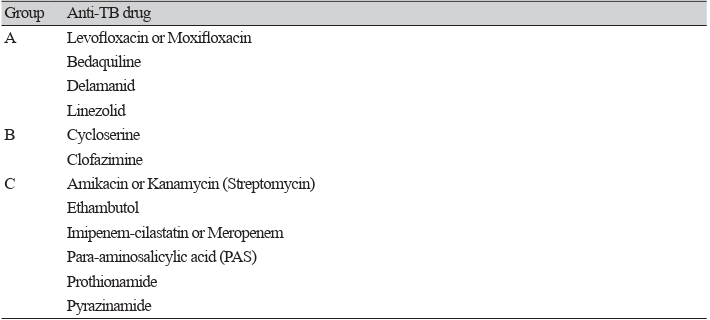
Table 1
Table 2
Table 3
Table 4

1. WHO. Global tuberculosis report 2025. Geneva: World Health Organization; 2025.

2. Pontali E, Matteelli A, Migliori GB. Drug-resistant tuberculosis. Curr Opin Pulm Med 2013;19:266-72.

3. Zhang Y and Yew WW. Mechanisms of drug resistance in Mycobacterium tuberculosis: update 2015. Int J Tuberc Lung Dis 2015;19:1276-89.

4. WHO. WHO consolidated guidelines on tuberculosis. Module 3: diagnosis. Geneva: World Health Organization; 2025.

5. KDCA. Korean guidelines for tuberculosis. 5th ed. Seoul: Korean Disease Control and Prevention Agency; 2025.

6. Nunn A, Phillips PPJ, Abubakar I. Treatment of pulmonary tuberculosis. Curr Opin Pulm Med 2013;19:273-9.

7. Jhun BW and Koh WJ. Treatment of isoniazid-resistant pulmonary tuberculosis. Tuberc Respir Dis 2020;83:20-30.

8. Kim YH, Suh GY, Chung MP, Kim H, Kwon OJ, Lim SY, et al. Treatment of isoniazid-resistant pulmonary tuberculosis. BMC Infect Dis 2008;8:6.

9. Nyang’wa BT, Berry C, Kazounis E, Motta I, Parpieva N, Tigay Z, et al. A 24-week, all-oral regimen for rifampin-resistant tuberculosis. N Engl J Med 2022;387:2331-43.

10. Mok J, Lee M, Kim DK, Kim JS, Jhun BW, Jo KW, et al. 9 months of delamanid, linezolid, levofloxacin, and pyrazinamide versus conventional therapy for treatment of fluoroquinolone-sensitive multidrug-resistant tuberculosis (MDR-END): a multicentre, randomised, open-label phase 2/3 non-inferiority trial in South Korea. Lancet 2022;400:1522-30.

11. Conradie F, Bagdasaryan TR, Borisov S, Howell P, Mikiashvili L, Ngubane N, et al. Bedaquiline-pretomanid-linezolid regimens for drug-resistant tuberculosis. N Engl J Med 2022;387:810-23.

12. Kim SJ. Drug-susceptibility testing in tuberculosis: methods and reliability of results. Eur Respir J 2005;25:564-9.

13. Wu X, Shang Y, Ren W, Wang W, Wang Y, Xue Z, et al. Minimum inhibitory concentration of cycloserine against Mycobacterium tuberculosis using the MGIT 960 system and a proposed critical concentration. Int J Infect Dis 2022;121:148-51.

14. WHO. Technical report on critical concentrations for drug susceptibility testing of isoniazid and the rifamycins (rifampicin, rifabutin and rifapentine). Geneva: World Health Organization; 2021.

15. Yu HJ, Kim TY, Kim G, Shim HJ, Kang OK, Kim S, et al. Performance evaluation of the BACTEC MGIT 960 system for rifampin drug-susceptibility testing of Mycobacterium tuberculosis using the current WHO critical concentration. J Clin Microbiol 2023;61:e01086-22.

16. Chan HH, Wang YC, Jou R. A simplified pyrazinamidase test for Mycobacterium tuberculosis pyrazinamide antimicrobial susceptibility testing. J Clin Microbiol 2024;62:e0122724.

17. Zhang Y, Shi W, Zhang W, Mitchison D. Mechanisms of pyrazinamide action and resistance. Microbiol Spectr 2014;2:MGM2-0023-2013.

18. Ei PW, Mon AS, Htwe MM, Win SM, Aye KT, San LL, et al. Pyrazinamide resistance and pncA mutations in drug resistant Mycobacterium tuberculosis clinical isolates from Myanmar. Tuberculosis 2020;125:102013.

19. Ramaswamy S and Musser JM. Molecular genetic basis of antimicrobial agent resistance in Mycobacterium tuberculosis: 1998 update. Tuber Lung Dis 1998;79:3-29.

20. Cohen KA, Manson AL, Desjardins CA, Abeel T, Earl AM. Deciphering drug resistance in Mycobacterium tuberculosis using whole-genome sequencing: progress, promise, and challenges. Genome Med 2019;11:45.

21. Ling DI, Zwerling AA, Pai M. GenoType MTBDR assays for the diagnosis of multidrug-resistant tuberculosis: a meta-analysis. Eur Respir J 2008;32:1165-74.

22. Havumaki J, Hillemann D, Ismail N, Omar SV, Georghiou SB, Schumacher SG, et al. Comparative accuracy of the REBA MTB MDR and Hain MTBDRplus line probe assays for the detection of multidrug-resistant tuberculosis: a multicenter, non-inferiority study. PLoS One 2017;12:e0173804.

23. Arentz M, Sorensen B, Horne DJ, Walson JL. Systematic review of the performance of rapid rifampicin resistance testing for drug-resistant tuberculosis. PLoS One 2013;8:e76533.

24. Yoo IY, Huh HJ, Kang OK, Jhun BW, Koh WJ, Lee NY. Advantages of the AdvanSure MDR-TB GenoBlot assay containing disputed rpoB mutation-specific probes in a routine clinical laboratory setting. Respir Med 2019;146:71-5.

25. Steingart KR, Schiller I, Horne DJ, Pai M, Boehme CC, Dendukuri N. Xpert® MTB/RIF assay for pulmonary tuberculosis and rifampicin resistance in adults. Cochrane Database Syst Rev 2014;2014:CD009593.

26. Dorman SE, Schumacher SG, Alland D, Nabeta P, Armstrong DT, King B, et al. Xpert MTB/ RIF Ultra for detection of Mycobacterium tuberculosis and rifampicin resistance: a prospective multicentre diagnostic accuracy study. Lancet Infect Dis 2018;18:76-84.

27. Horne DJ, Zifodya JS, Shapiro AE, Church EC, Kreniske JS, Kay AW, et al. Xpert MTB/RIF Ultra assay for pulmonary tuberculosis and rifampicin resistance in adults and adolescents. Cochrane Database Syst Rev 2025;7:CD009593.

28. Opota O, Mazza-Stalder J, Greub G, Jaton K. The rapid molecular test Xpert MTB/RIF ultra: towards improved tuberculosis diagnosis and rifampicin resistance detection. Clin Microbiol Infect 2019;25:1370-6.

29. Sung J, Nantale M, Nalutaaya A, Biché P, Mukiibi J, Kamoga CE, et al. Evidence for tuberculosis in individuals with Xpert Ultra “Trace” sputum during screening of high-burden communities. Clin Infect Dis 2024;78:723-9.

30. Cabibbe AM, Walker TM, Niemann S, Cirillo DM. Whole genome sequencing of Mycobacterium tuberculosis. Eur Respir J 2018;52:1801163.

31. Schwab TC, Perrig L, Göller PC, Guebely De la Hoz FF, Lahousse AP, Minder B, et al. Targeted next-generation sequencing to diagnose drug-resistant tuberculosis: a systematic review and meta-analysis. Lancet Infect Dis 2024;24:1162-76.

32. Van Deun A, Aung KJM, Hossain A, De Rijk P, Gumusboga M, Rigouts L, et al. Disputed rpoB mutations can frequently cause important rifampicin resistance among new tuberculosis patients. Int J Tuberc Lung Dis 2015;19:185-90.

33. Gurbanova E, Mehdiyev R, Blondal K, Tahirli R, Mirzayev F, Hillemann D, et al. Mitigation of discordant rifampicin-susceptibility results obtained by Xpert Mycobacterium tuberculosis/rifampicin and mycobacterium growth indicator tube. Microb Drug Resist 2017;23:1045-52.

34. Al-Mutairi NM, Ahmad S, Mokaddas E, Eldeen HS, Joseph S. Occurrence of disputed rpoB mutations among Mycobacterium tuberculosis isolates phenotypically susceptible to rifampicin in a country with a low incidence of multidrug-resistant tuberculosis. BMC Infect Dis 2019;19:3.

35. Ocheretina O, Escuyer VE, Mabou MM, Royal-Mardi G, Collins S, Vilbrun SC, et al. Correlation between genotypic and phenotypic testing for resistance to rifampin in Mycobacterium tuberculosis clinical isolates in Haiti: investigation of cases with discrepant susceptibility results. PLoS One 2014;9:e90569.

36. Pang Y, Ruan YZ, Zhao J, Chen C, Xu CH, Su W, et al. Diagnostic dilemma: treatment outcomes of tuberculosis patients with inconsistent rifampicin susceptibility. Int J Tuberc Lung Dis 2014;18:357-62.

37. Van Deun A, Decroo T, Aung KJM, Hossain MA, Gumusboga M, De Rijk WB, et al. Mycobacterium tuberculosis borderline rpoB mutations: emerging from the unknown. Eur Respir J 2021;58:2100783.

38. Kim CK, Huh HJ, Park JS, Kim T, Sohn JH. Comparative evaluation of critical concentrations for detecting borderline rifampin resistance in Mycobacterium tuberculosis. Ann Clin Microbiol 2023;26:139-45.

39. Ngabonziza JCS, Decroo T, Migambi P, Habimana YM, Deun AV, Meehan CJ, et al. Prevalence and drivers of false-positive rifampicin-resistant Xpert MTB/RIF results: a prospective observational study in Rwanda. Lancet Microbe 2020;1:e74-83.

40. Cuella-Martin I, Hakizayezu F, Ahmed A, Runyambo D, Niyompano H, Keysers J, et al. Paucibacillary tuberculosis drives the low positive predictive value of Xpert MTB/RIF ultra for rifampicin resistance detection in low-prevalence settings. Clin Infect Dis 2025;81:372-8.

41. Ocheretina O, Byrt E, Mabou MM, Royal-Mardi G, Merveille YM, Rouzier V, et al. False-positive rifampin resistant results with Xpert MTB/RIF version 4 assay in clinical samples with a low bacterial load. Diagn Microbiol Infect Dis 2016;85:53-5.