Annals of Clinical Microbiology, The official Journal of the Korean Society of Clinical Microbiology

6

Weeks in Review

4

Weeks to Publication
Indexed in KCI, KoreaMed, Synapse, DOAJ
Open Access, Peer Reviewed
pISSN 2288-0585 eISSN 2288-6850
Brief communication

Whole-genome characterization of two azithromycin-resistant Neisseria gonorrhoeae ST1600 isolates from Busan, South Korea

1Department of Laboratory Medicine, Gangneung Asan Hospital, University of Ulsan College of Medicine, Gangneung, Korea
2Department of Laboratory Medicine and Research Institute of Bacterial Resistance, Yonsei University College of Medicine, Seoul, Korea
3Department of Laboratory Medicine, National Health Insurance Service Ilsan Hospital, Goyang, Korea
4Seoul Clinical Laboratories Academy, Yongin, Korea

Correspondence to Kyoung Ho Roh E-mail: director.roh@gmail.com

Ann Clin Microbiol 2026;29(2):8. https://doi.org/10.5145/ACM.2026.29.2.8
Received on 10 April 2026, Revised on 27 May 2026, Accepted on 7 June 2026, Published on 20 June 2026.
Copyright © Korean Society of Clinical Microbiology.
This is an Open Access article which is freely available under the Creative Commons Attribution-NonCommercial-NoDerivatives 4.0 International License (CC BY-NC-ND) (https://creativecommons.org/licenses/by-nc-nd/4.0/).

Abstract

Azithromycin-resistant Neisseria gonorrhoeae poses a threat to the efficacy of gonorrhea treatment. We report the whole-genome characterization of two azithromycin-resistant N. gonorrhoeae ST1600 isolates collected in Busan, South Korea, in 2018 and 2019. Both isolates showed moderate azithromycin resistance (minimum inhibitory concentration 32 µg/mL) mediated by the 23S rRNA C2611T mutation in all four alleles and the -35A deletion in the mtrR promoter, while harboring distinct non-mosaic penA alleles without reduced susceptibility to extended-spectrum cephalosporins. Multilocus sequence typing classified both isolates as ST1600, which is related to ST7363. N. gonorrhoeae multi-antigen sequence typing assigned the 2018 isolate to ST16190, whereas the 2019 isolate represented a novel NG-MAST type closely related to ST16190 (differing by a single SNP in porB). Taken together, these data suggest a limited local transmission cluster with short-term persistence and microevolution, rather than widespread sustained clonal dissemination. Continued phenotypic and genomic surveillance is needed to monitor azithromycin resistance in N. gonorrhoeae and inform national treatment strategies.

Keywords

Azithromycin; Drug resistance, bacterial; Gonorrhea; Neisseria gonorrhoeae; Whole genome sequencing

Until 2006, gonorrhea was South Korea’s most prevalent bacterial sexually transmitted infection, but its incidence has since declined, primarily affecting individuals in their twenties [1]. In contrast, rates in the United States have increased, particularly among individuals aged 15–24 years [2]. Globally, ciprofloxacin resistance remains high, azithromycin resistance is increasing, and susceptibility to ceftriaxone is declining [3]. This trend has made treatment increasingly challenging and has complicated the selection of appropriate treatment regimens for gonorrhea.

Since 2014, we have analyzed Neisseria gonorrhoeae isolates from 35 hospitals in South Korea, and in 2018 and 2019, identified two strains with moderate azithromycin resistance. Azithromycin resistance and decreased susceptibility in N. gonorrhoeae have previously been reported in South Korea [4]. However, detailed whole-genome characterization of such isolates remains limited. Here, we report the genomic characterization of these two isolates in the context of evolving gonococcal treatment guidelines. These isolates represent, to our knowledge, the first azithromycin-resistant N. gonorrhoeae ST1600 strains reported in South Korea, and their N. gonorrhoeae multi-antigen sequence typing (NG-MAST) profiles differ from those of the azithromycin-resistant NG-MAST ST4207 and ST6762 lineages with elevated azithromycin minimum inhibitory concentrations (MICs) previously described in Japan [5].

We characterized these isolates as follows:

Specimens were inoculated onto modified Thayer-Martin medium and identified by MALDI-TOF mass spectrometry (Bruker) and biochemical testing using Vitek NHI cards (bioMérieux). Azithromycin susceptibility was assessed by the agar dilution method using GC II agar supplemented with 1% IsoVitaleX, according to the Clinical and Laboratory Standards Institute and European Committee on Antimicrobial Susceptibility Testing guidelines [6,7]. Sequencing libraries were prepared from 50 ng of extracted DNA using the Twist Library Preparation EF Kit (Twist Bioscience), according to the manufacturer’s instructions. Paired-end sequencing was performed on a NovaSeq 6000 system (Illumina) using 2 × 150 bp reads. Library quantity and fragment size distribution were assessed using Qubit fluorometric assays (Thermo Fisher Scientific) and the Agilent 4200 TapeStation system (Agilent Technologies). FASTQ files were de novo assembled using Unicycler v0.4.0, and the resulting assemblies were evaluated for sequencing depth and standard assembly quality metrics before downstream analyses. Assembled FASTA files were analyzed using Pathogenwatch and the PubMLST database to determine NG-MAST and multilocus sequence typing (MLST) profiles, penA and 23S rRNA variants, and antimicrobial resistance determinants. Antimicrobial resistance determinants were identified based on curated N. gonorrhoeae reference schemes within Pathogenwatch and PubMLST and were confirmed when sequence identity and coverage relative to reference alleles were ≥ 95% and ≥ 90%, respectively.

The 2018 strain exhibited an azithromycin MIC of 32 µg/mL and resistance to penicillin G, tetracycline, and ciprofloxacin, while remaining susceptible to ceftriaxone and spectinomycin (Table 1). It carried a nonmosaic penA-109.001 allele with an A502V mutation, a -35A deletion in the mtrR promoter, and a C2611T mutation in all four 23S rRNA alleles. It was classified as ST1600 by MLST, and NG-MAST assigned it to ST16190 based on the porB 9414 and tbpB 831 alleles. The 2019 strain had a similar antimicrobial resistance pattern, with an azithromycin MIC of 32 µg/mL, but carried a non-mosaic penA-120.001 allele. It differed from the 2018 strain in the porB 9414 allele by a single-nucleotide polymorphism (A169G), yielding a novel NG-MAST type with the same tbpB 831 allele and MLST ST1600.


Table 1. Characteristics of two azithromycin-resistant Neisseria gonorrhoeae isolates

Characteristics Year of isolation
2018 2019
Area of isolation (city) Busan Busan
Antimicrobial susceptibility (MIC (µg/mL) and interpretation)
Azithromycin 32, R 32, R
Ciprofloxacin 32, R 16, R
Spectinomycin 32, S 16, S
Tetracycline 2, R 4, R
Penicillin G 2, R 2, R
Cefixime 0.06, S 0.03, S
Ceftriaxone 0.06, S 0.03, S
Resistance determinants
23S rRNA C2611T mutation (4 alleles) C2611T mutation (4 alleles)
mtrR promoter -35A deletion -35A deletion
Epidemiology
NG-MAST ST16190 ST16190a)
MLST ST1600 ST1600
penA genotype 109.001 120.001

a)A169G single-nucleotide polymorphism in porB 9414 and an identical tbpB allele 831.
Abbreviations: MIC, minimum inhibitory concentration; R, resistant; S, susceptible; NG-MAST, Neisseria gonorrhoeae multi-antigen sequence typing; MLST, multilocus sequence typing.

Two isolates collected in Busan, South Korea, in 2018 and 2019 shared a common molecular resistance profile characterized by moderate azithromycin MICs of 32 µg/mL and C2611T substitutions in all four 23S rRNA alleles, together with a -35A deletion in the mtrR promoter. This combination of targetsite modification and enhanced efflux is consistent with previously described mechanisms of moderate azithromycin resistance in N. gonorrhoeae, rather than the high-level azithromycin resistance typically associated with 23S rRNA A2059G mutations [8].

Both isolates belonged to MLST ST1600 (126-39-67-78-148-153-65), a lineage closely related to ST7363 (59-39-67-78-148-153-65) and previously associated with reduced susceptibility to extended-spectrum cephalosporins in East Asia [9]. However, no increase in ceftriaxone MIC was observed, supporting previous observations that antimicrobial susceptibility phenotypes within this lineage are determined primarily by specific resistance determinants, such as penA alleles, rather than by MLST background alone.

NG-MAST analysis identified the two isolates as ST16190 and a closely related ST16190 variant, suggesting sporadic emergence or recent recombination rather than clonal dissemination. Similar lowto-moderate azithromycin resistance profiles associated with C2611T and mtrR alterations have been reported in South Africa and South America [8,10]. In contrast, repeated detection of identical NG-MAST or N. gonorrhoeae sequence typing for antimicrobial resistance types has been used to characterize clonal expansion in high-level resistance lineages reported from Japan [11]. Together, the nearly identical resistance determinants, shared MLST ST1600 background, and common geographic origin in Busan support a local epidemiological link and microevolution.

N. gonorrhoeae has developed resistance to all first-line antimicrobials previously used for the treatment of gonorrhea, with high-level azithromycin resistance (MIC ≥ 256 µg/mL) reported in several countries [12]. Current WHO and national guidelines recommend ceftriaxone-based regimens as the mainstay of treatment and generally discourage routine dual therapy with azithromycin because of rising macrolide resistance [13]. In South Korea, ceftriaxone remains the preferred agent, with spectinomycin or gentamicin plus highdose azithromycin reserved for situations in which cephalosporins cannot be used [1]. The emergence of azithromycin-resistant N. gonorrhoeae, as observed in our two isolates, is consistent with these evolving recommendations and underscores the need for cautious use of azithromycin-containing regimens in settings where macrolide resistance is increasing.

In conclusion, we describe two azithromycin-resistant N. gonorrhoeae ST1600 isolates from Busan, South Korea, with moderate azithromycin MICs (32 µg/mL) mediated by the 23S rRNA C2611T mutation and the -35A deletion in the mtrR promoter. Their high genetic similarity but distinct NG-MAST types suggest local microevolution and sporadic emergence rather than sustained clonal spread. As Busan is a major urban center with notable domestic and international connectivity, continued integrated phenotypic and genomic surveillance is warranted to detect emerging resistant gonococcal lineages and inform national treatment strategies.

Ethics statement

The research did not provide demographic information to the patient. Following internal sentinel surveillance processes, all gonococcal isolates were grown and stored. This research was also given an exemption from the ethics approval requirement because it performed as one of the projects of the national sentinel surveillance program supported by the Korean Centers for Disease Control and Prevention.

Conflicts of interest

No potential conflicts of interest relevant to this article were reported.

Funding

None.

Data availability

The whole-genome shotgun assembly has been deposited in DDBJ/ENA/GenBank under accession number JBYPZC000000000 (BioProject PRJNA1469664; BioSample SAMN60371742).

Acknowledgments

None.

Authors' contributions

Conceptualization: Lee H; Methodology: Seo YH; Investigation: Roh KH; Supervision: Lee K; Writing – Original Draft: Seo YH, Liu C; Writing – Review & Editing: Roh KH, Lee H, Lee K

References

1. Yang HJ, Lee HM, Lee SJ, Choi JB, Bae S, Jung JH, et al. 2023 Korean Association of Urogenital Tract Infection and Inflammation guidelines for gonococcal infection. Investig Clin Urol 2024;65:1-8.

2. Pollock ED, Clay PA, Kreisel KM, Spicknall IH. Estimated incidence and prevalence of gonorrhea in the United States, 2006-2019. Sex Transm Dis 2023;50:188-95.

3. Unemo M, Lahra MM, Escher M, Eremin S, Cole MJ, Galarza P, et al. WHO global antimicrobial resistance surveillance for Neisseria gonorrhoeae 2017-18: a retrospective observational study. Lancet Microbe 2021;2:e627-36.

4. Lee H, Unemo M, Kim HJ, Seo Y, Lee K, Chong Y. Emergence of decreased susceptibility and resistance to extended-spectrum cephalosporins in Neisseria gonorrhoeae in Korea. J Antimicrob Chemother 2015;70:2536-42.

5. Miura M, Shigemura K, Osawa K, Nakanishi N, Nomoto R, Onishi R, et al. Genetic characteristics of azithromycin-resistant Neisseria gonorrhoeae collected in Hyogo, Japan during 2015-2019. J Med Microbiol 2022;71:10.1099/jmm.0.001533.

6. Clinical and Laboratory Standards Institute (CLSI). Performance standards for antimicrobial susceptibility testing. 31st ed. CLSI supplement M100. Wayne, PA: CLSI; 2021.

7. European Committee on Antimicrobial Susceptibility Testing. Breakpoint tables for interpretation of MICs and zone diameters. Version 11.0, 2021. https://www.eucast.org [Online] (last visited on 8 April 2026).

8. Müller EE, Gumede LYE, Maseko DV, Mahlangu MP, Venter JME, Da Costa Dias B, et al. Emergence of high-level azithromycin-resistant Neisseria gonorrhoeae causing male urethritis in Johannesburg, South Africa, 2021. Sex Health 2024;21:SH23143.

9. Peng JP, Yin YP, Chen SC, Yang J, Dai XQ, Zheng HP, et al. A whole-genome sequencing analysis of Neisseria gonorrhoeae isolates in China: an observational study. EClinicalMedicine 2019;7:47-54.

10. Gianecini RA, Poklepovich T, Golparian D, Cuenca N, Tuduri E, Unemo M, et al. Genomic epidemiology of azithromycin-nonsusceptible Neisseria gonorrhoeae, Argentina, 2005-2019. Emerg Infect Dis 2021;27:2369-78.

11. Shimuta K, Lee K, Yasuda M, Furubayashi K, Uchida C, Nakayama SI, et al. Characterization of 2 Neisseria gonorrhoeae strains with high-level azithromycin resistance isolated in 2015 and 2018 in Japan. Sex Transm Dis 2021;48:e85-7.

12. Unemo M and Nicholas RA. Emergence of multidrug-resistant, extensively drug-resistant and untreatable gonorrhea. Future Microbiol 2012;7:1401-22.

13. World Health Organization. Updated recommendations for the treatment of Neisseria gonorrhoeae, Chlamydia trachomatis and Treponema pallidum (syphilis), and new recommendations on syphilis testing and partner services. Geneva: World Health Organization; 2024.
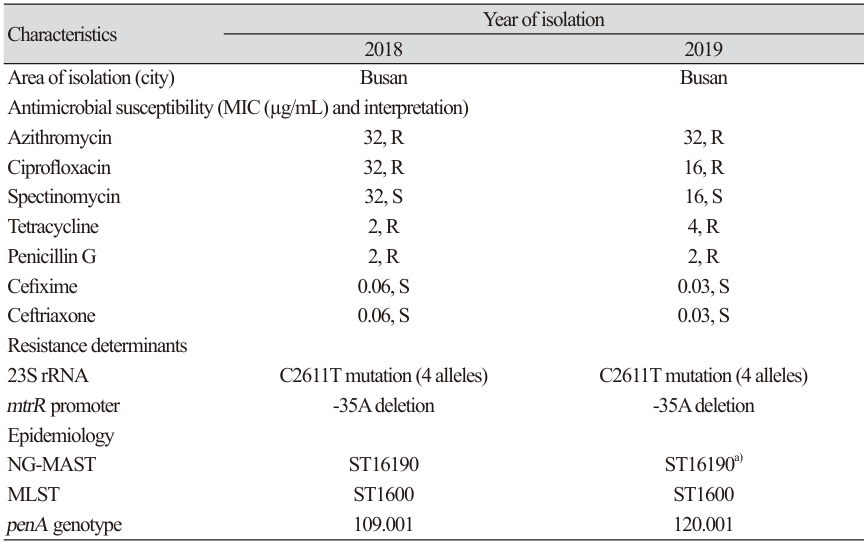
Table 1

1. Yang HJ, Lee HM, Lee SJ, Choi JB, Bae S, Jung JH, et al. 2023 Korean Association of Urogenital Tract Infection and Inflammation guidelines for gonococcal infection. Investig Clin Urol 2024;65:1-8.

2. Pollock ED, Clay PA, Kreisel KM, Spicknall IH. Estimated incidence and prevalence of gonorrhea in the United States, 2006-2019. Sex Transm Dis 2023;50:188-95.

3. Unemo M, Lahra MM, Escher M, Eremin S, Cole MJ, Galarza P, et al. WHO global antimicrobial resistance surveillance for Neisseria gonorrhoeae 2017-18: a retrospective observational study. Lancet Microbe 2021;2:e627-36.

4. Lee H, Unemo M, Kim HJ, Seo Y, Lee K, Chong Y. Emergence of decreased susceptibility and resistance to extended-spectrum cephalosporins in Neisseria gonorrhoeae in Korea. J Antimicrob Chemother 2015;70:2536-42.

5. Miura M, Shigemura K, Osawa K, Nakanishi N, Nomoto R, Onishi R, et al. Genetic characteristics of azithromycin-resistant Neisseria gonorrhoeae collected in Hyogo, Japan during 2015-2019. J Med Microbiol 2022;71:10.1099/jmm.0.001533.

6. Clinical and Laboratory Standards Institute (CLSI). Performance standards for antimicrobial susceptibility testing. 31st ed. CLSI supplement M100. Wayne, PA: CLSI; 2021.

7. European Committee on Antimicrobial Susceptibility Testing. Breakpoint tables for interpretation of MICs and zone diameters. Version 11.0, 2021. https://www.eucast.org [Online] (last visited on 8 April 2026).

8. Müller EE, Gumede LYE, Maseko DV, Mahlangu MP, Venter JME, Da Costa Dias B, et al. Emergence of high-level azithromycin-resistant Neisseria gonorrhoeae causing male urethritis in Johannesburg, South Africa, 2021. Sex Health 2024;21:SH23143.

9. Peng JP, Yin YP, Chen SC, Yang J, Dai XQ, Zheng HP, et al. A whole-genome sequencing analysis of Neisseria gonorrhoeae isolates in China: an observational study. EClinicalMedicine 2019;7:47-54.

10. Gianecini RA, Poklepovich T, Golparian D, Cuenca N, Tuduri E, Unemo M, et al. Genomic epidemiology of azithromycin-nonsusceptible Neisseria gonorrhoeae, Argentina, 2005-2019. Emerg Infect Dis 2021;27:2369-78.

11. Shimuta K, Lee K, Yasuda M, Furubayashi K, Uchida C, Nakayama SI, et al. Characterization of 2 Neisseria gonorrhoeae strains with high-level azithromycin resistance isolated in 2015 and 2018 in Japan. Sex Transm Dis 2021;48:e85-7.

12. Unemo M and Nicholas RA. Emergence of multidrug-resistant, extensively drug-resistant and untreatable gonorrhea. Future Microbiol 2012;7:1401-22.

13. World Health Organization. Updated recommendations for the treatment of Neisseria gonorrhoeae, Chlamydia trachomatis and Treponema pallidum (syphilis), and new recommendations on syphilis testing and partner services. Geneva: World Health Organization; 2024.
