1Department of Laboratory Medicine, Seoul National University Bundang Hospital, Seoul National University College of Medicine, Seongnam, Korea
2Department of Laboratory Medicine, Green Cross Laboratories, Yongin, Korea
*These authors contributed equally to this work.
Correspondence to Jeong Su Park, E-mail: mdmicrobe@gmail.com
Ann Clin Microbiol 2025;28(4):24. https://doi.org/10.5145/ACM.2025.28.4.5
Received on 12 November 2025, Revised on 10 December 2025, Accepted on 10 December 2025, Published on 20 December 2025.
Copyright © Korean Society of Clinical Microbiology.
This is an Open Access article which is freely available under the Creative Commons Attribution-NonCommercial-NoDerivatives 4.0 International License (CC BY-NC-ND) (https://creativecommons.org/licenses/by-nc-nd/4.0/).
Background: Mycobacterium avium complex (MAC) is a major cause of pulmonary nontuberculous mycobacterial disease; however, treatment outcomes remain suboptimal. Phenotypic drug susceptibility testing (DST) is conditionally recommended; however, conventional broth microdilution is labor-intensive. The Sensititre SLOMYCO® panel offers a standardized platform for DST of slowly growing mycobacteria.
Methods: Eighty-six clinical MAC isolates (48 M. avium and 38 M. intracellulare) from respiratory specimens were tested for 13 antimicrobials using the SLOMYCO panel and reference Clinical and Laboratory Standards Institute (CLSI) broth microdilution methods at the Korean Institute of Tuberculosis. Essential agreement (EA) was defined as minimum inhibitory concentrations within ± 1 dilution, and categorical agreement (CA) was based on CLSI 2018 breakpoints for clarithromycin, amikacin, moxifloxacin, and linezolid.
Results: The EA was high for amikacin (90%), moxifloxacin (92%), linezolid (92%), and ethambutol (98%). Moderate EA was observed for clarithromycin (79%), ciprofloxacin (67%), and doxycycline (63%), and low EA was observed for trimethoprim-sulfamethoxazole (34%). The CA values were 100%, 77.9%, 69.8%, and 47.7% for clarithromycin, amikacin, moxifloxacin, and linezolid, respectively. All isolates were clarithromycin-susceptible according to both methods, and no clarithromycin- or amikacin-resistant isolates were detected.
Conclusion: The SLOMYCO DST system demonstrated high agreement with the reference methods for clarithromycin and amikacin in the tested susceptible population. The variability in the results for moxifloxacin and linezolid highlights the need for refined breakpoints. The validation of resistant isolates is essential before the SLOMYCO system can be recommended for comprehensive clinical applications.
Amikacin, Clarithromycin, Microbial sensitivity tests, Mycobacterium avium complex, Nontuberculous mycobacteria
Nontuberculous mycobacteria (NTM) are ubiquitous environmental organisms that are increasingly recognized as human pathogens [1]. The Mycobacterium avium complex (MAC), comprising M. avium, M. intracellulare, and related species, is the most prevalent cause of pulmonary NTM disease worldwide [2,3]. MAC can cause lymphadenitis and disseminated infections, particularly in immunocompromised hosts [4].
The reference method for NTM drug susceptibility testing (DST) is the broth microdilution technique performed in either Middlebrook 7H9 or cation-adjusted Mueller-Hinton broth, following Clinical and Laboratory Standards Institute (CLSI) standard M24 [5]. This method involves preparing two-fold dilutions of antibiotics and determining the minimum inhibitory concentration (MIC) after incubation, typically 7–14 days for the MAC [6]. Although reliable, reference broth microdilution is manual and time-consuming, requiring careful preparation of drug panels and interpretation of endpoints. In practice, many laboratories lack experience with NTM DST, and interlaboratory variability in the MIC readings can be substantial.
Commercial platforms have been developed to streamline MAC susceptibility testing. The Sensititre SLOMYCO panel (Thermo Fisher/TREK Diagnostics) is a 96-well microtiter plate preloaded with lyophilized antibiotics in fixed concentration ranges [7]. This panel is designed for slowly growing mycobacteria (hence “SLOMYCO”) and includes 13 antimicrobials relevant to NTM infections: amikacin, ciprofloxacin, clarithromycin, doxycycline, ethambutol, ethionamide, isoniazid, linezolid, moxifloxacin, rifabutin, rifampin, streptomycin, and trimethoprim-sulfamethoxazole. A growth control well is provided, and results are read visually, as with conventional MIC plates. The SLOMYCO system offers several potential advantages. It obviates the need for laboratories to prepare their own drug dilutions, ensures consistent drug potency and ranges, and can be easily incorporated into routine workflows. Early studies demonstrated the utility of this panel for clarithromycin testing in MAC. Babady et al. [7] found 90% agreement with the radiometric BACTEC 460 method and 93% concordance with manual microdilution for clarithromycin MICs. However, comprehensive evaluations of the SLOMYCO panel for multiple drugs in MAC are limited. A few comparative studies have yielded mixed results, with some reporting high agreement with certain drugs and others reporting discrepancies. For example, a recent evaluation noted only 60% overall agreement between SLOMYCO and traditional MIC testing for clarithromycin, despite high concordance for amikacin [8]. These findings underscore the need to rigorously assess the panel performance for all relevant drugs in MAC.
In this study, we aimed to evaluate the SLOMYCO Sensititre panel method for DST of M. avium complex isolates in comparison with the CLSI reference broth microdilution method. We assessed the essential agreement (EA) of the MIC values, categorical agreement (CA) based on the CLSI breakpoints, and error rates between the two methods. Our goal was to determine whether the SLOMYCO panel could serve as a reliable and efficient alternative to MAC susceptibility testing in clinical laboratories.
This retrospective study evaluated the diagnostic accuracy, adhering to the Standards for Reporting Diagnostic Accuracy Studies guidelines (https://www.equator-network.org/reporting-guidelines/stard/).
This study included 86 clinical MAC isolates, including 48 M. avium and 38 M. intracellulare. This study included all consecutive MAC isolates recovered from respiratory specimens (sputum and bronchoalveolar lavage fluids) during a four-month period (September to December 2020) at Seoul National University Bundang Hospital (Seongnam, South Korea), where patients were evaluated or treated for suspected NTM lung disease. Mycobacteria isolated from the cultures were tested for species identification. Nucleic acids were extracted by heating in a 5% Chelex 100 solution (Bio-Rad Laboratories). Differentiation between the M. tuberculosis complex (MTBC) and NTM was initially performed using a real-time polymerase chain reaction (PCR) assay targeting the senX3-regX3 intergenic region. Species identification was conducted using a laboratory-developed three-channel multiplex real-time PCR assay and melting curve analysis targeting three regions: the 16S rRNA general region, hsp65 region, and 16S rRNA hypervariable region A. This three-channel multiplex real-time PCR assay can simultaneously detect 17 NTM species and MTBC. To further confirm NTM identification at the species level, a rpoB PCR restriction fragment length polymorphism (PCR-RFLP) test was performed, as previously reported [9–11].
The final identification results were determined by integrating the results of senX3-regX3 screening, multiplex real-time PCR, and rpoB PCR-RFLP analysis. Although these molecular methods are practical for routine clinical use, they may not provide the same high-resolution species discrimination as gene sequencing (e.g., rpoB or 16S rRNA sequencing). However, as the CLSI drug susceptibility breakpoints are identical for M. avium and M. intracellulare, this limitation did not affect the interpretation of the DST results in this study. Only one isolate per patient was included (either the initial diagnostic isolate or a subsequent isolate obtained during therapy, if available). The study was conducted under institutional review board approval, and all isolates were de-identified and stored at -70°C until testing.
All isolates were tested for antimicrobial susceptibility using two methods in parallel.
1. Reference Broth Microdilution (CLSI M24-A3): All isolates were submitted to the Korean Institute of Tuberculosis (KIT) for reference DST, performed according to the CLSI M24 standard for mycobacteria. Briefly, a bacterial suspension equivalent to a McFarland standard (0.5) was prepared from each isolate (colonies grown on Middlebrook 7H10 agar). This suspension was diluted in broth and used to inoculate sterile 96-well microdilution plates containing two-fold serial dilutions of each antibiotic. Mueller-Hinton broth supplemented with oleic acid-albumin-dextrose-catalase was used as the culture medium, consistent with CLSI recommendations for MAC DST. Plates were incubated at 35°C in ambient air and examined after 7 and up to 14 days or until the growth control wells showed visible turbidity. The MIC was defined as the lowest concentration of the drug that prevented visible growth (100% inhibition) compared to the growth control. For quality control, M. avium ATCC 700898 was tested in parallel.
The panel of drugs tested using the reference method mirrored those present on the SLOMYCO plates (except for ethionamide, isoniazid, rifampin, rifabutin, and streptomycin). The key drugs of interest were amikacin, clarithromycin, moxifloxacin, linezolid, ciprofloxacin, ethambutol, doxycycline, and trimethoprim-sulfamethoxazole. Where applicable, MIC interpretive criteria for MAC were applied as defined by CLSI M24-A3 (2018): for clarithromycin, susceptible (S) ≤ 8 mg/L, intermediate (I) 16 mg/L, and resistant (R) ≥ 32 mg/L; for amikacin, S ≤ 16 mg/L, I = 32 mg/L, R ≥ 64 mg/L; for moxifloxacin, S ≤ 1 mg/ L, I = 2 mg/L, R ≥ 4 mg/L; and for linezolid, S ≤ 8 mg/L, I = 16 mg/L, R ≥ 32 mg/L [5]. For drugs without established breakpoints (e.g., doxycycline, ciprofloxacin, ethambutol, and trimethoprim-sulfamethoxazole), only the MIC was recorded without a categorical interpretation.
2. SLOMYCO Sensititre panel: The SLOMYCO Sensititre plate (Thermo Fisher Scientific, catalog SLOMYCO) is a sealed 96-well microdilution plate containing dehydrated antibiotics at predefined concentrations. Each isolate was tested on a SLOMYCO plate according to the manufacturer’s instructions and CLSI guidelines. Inocula were prepared by adjusting a fresh culture of the isolate to a 0.5 McFarland standard in sterile water. A 1:100 dilution of this suspension was added to Mueller-Hinton broth (Thermo Fisher Scientific), as recommended. Then, 100 µL of the diluted inoculum was dispensed into each well of the SLOMYCO plate, which included a positive growth control well (no drug) and antibiotic-containing wells. The drugs and concentration ranges on the panel were: amikacin (1–64 µg/mL), ciprofloxacin (0.12–16 µg/mL), clarithromycin (0.06–64 µg/mL), doxycycline (0.12–16 µg/mL), ethambutol (0.5–16 µg/mL), ethionamide (0.3–20 µg/mL), isoniazid (0.25–8 µg/mL), linezolid (1–64 µg/mL), moxifloxacin (0.12–8 µg/ mL), rifabutin (0.25–8 µg/mL), rifampin (0.12–8 µg/mL), streptomycin (0.5–64 µg/mL), and trimethoprim-sulfamethoxazole (TMP/SXT 0.12/2.38–8/152 µg/mL). The plates were sealed and incubated at 35°C in a non-CO2 incubator. The plates were examined after 10–14 days, and the time to reading was determined as the point at which the control well showed visible growth comparable to that of a 1+ McFarland plate (according to panel instructions, typically 7–10 days for MAC). The MIC for each drug was read with the aid of a mirrored viewer, defined as the lowest drug concentration with no visible growth (or only a faint haze considered ≈ 99% inhibition). For clarithromycin, any isolate for which growth was observed in wells up to 8 µg/mL but not at higher concentrations was incubated for an additional 7 days (total 14 days) to check for late-appearing resistant subpopulations (inducible resistance). The final clarithromycin MICs were recorded at 14 days to ensure the detection of inducible resistance (per CLSI guidelines for MAC).
For each isolate and drug, the MICs obtained using the SLOMYCO panel were compared with those obtained using the reference method. EA was defined as the percentage of isolates for which the SLOMYCO panel MIC was within ± 1 doubling dilution of the reference MIC. Isolates for which one or both methods yielded an off-scale MIC were excluded from the EA calculations. CA was calculated only for drugs with CLSI-defined breakpoints (amikacin, clarithromycin, moxifloxacin, and linezolid). CA is the percentage of isolates for which the SLOMYCO result fell into the same category (S, I, or R) as the reference result. Discrepancies were classified as minor, major, or very major errors, according to standard definitions. The analysis was descriptive and focused on the agreement percentages and error rates. Confidence intervals (95% CI) for the proportions were calculated using the exact binomial method (SPSS version 25.0; IBM Corp.).
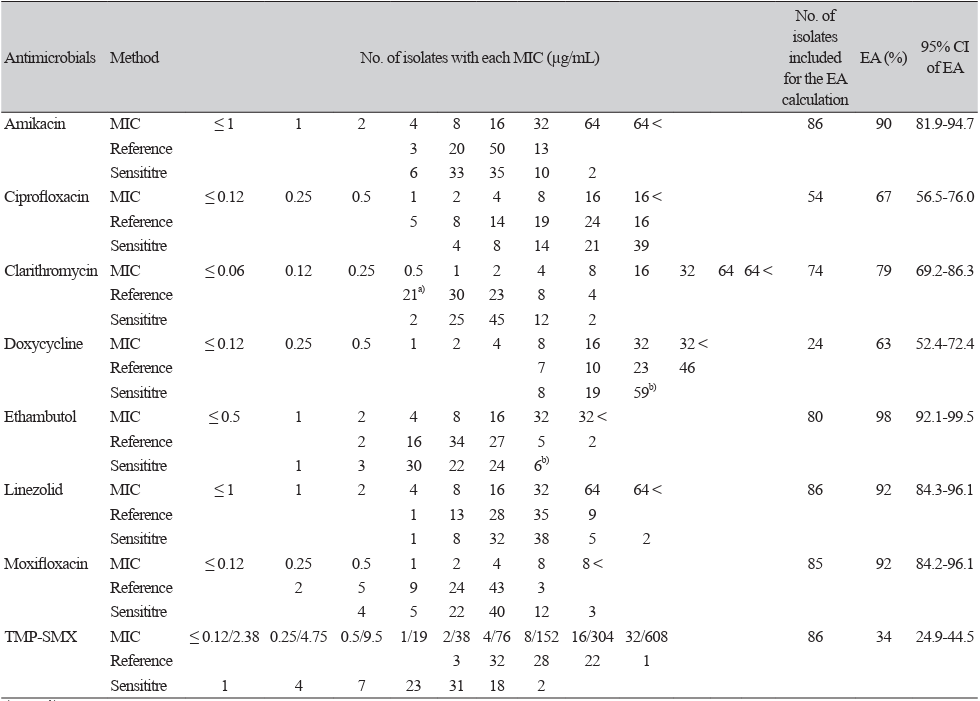
A comparison of the MIC results obtained by the reference broth microdilution and SLOMYCO panel is summarized in Table 1 (MIC distribution and EA by drug). Overall, the MIC values obtained using the two methods were in close agreement for several drugs, but substantial differences were observed for other drugs.
Table 1. Comparison of MICs and EA between the reference broth microdilution and Sensititre SLOMYCO panel for mycobacterial isolates
| Antimicrobials | Method | No. of isolates with each MIC (µg/mL) | No. of isolates included for the EA calculation | EA (%) | 95% CI of EA | |||||||||||
|---|---|---|---|---|---|---|---|---|---|---|---|---|---|---|---|---|
| Amikacin | MIC | ≤1 | 1 | 2 | 4 | 8 | 16 | 32 | >64 | 64< | 86 | 90 | 81.9-94.7 | |||
| Reference | 3 | 20 | 50 | 13 | ||||||||||||
| Sensititre | 6 | 33 | 35 | 10 | 2 | |||||||||||
| Ciprofloxacin | MIC | ≤0.12 | 0.25 | 0.5 | 1 | 2 | 4 | 8 | >16 | 16< | 54 | 67 | 56.5-76.0 | |||
| Reference | 5 | 8 | 14 | 19 | 24 | 16 | ||||||||||
| Sensititre | 4 | 8 | 14 | 21 | 39 | |||||||||||
| Clarithromycin | MIC | ≤0.06 | 0.12 | 0.25 | 0.5 | 1 | 2 | 4 | 8 | 16 | 32 | 64 | >64 | 74 | 79 | 69.2-86.3 |
| Reference | 21a) | 30 | 23 | 8 | 4 | |||||||||||
| Sensititre | 2 | 25 | 45 | 12 | 2 | |||||||||||
| Doxycycline | MIC | ≤0.12 | 0.25 | 0.5 | 1 | 2 | 4 | 8 | 16 | 32 | >32 | 24 | 63 | 52.4-72.4 | ||
| Reference | 7 | 10 | 23 | 46 | ||||||||||||
| Sensititre | 8 | 19 | 59b) | |||||||||||||
| Ethambutol | MIC | ≤0.5 | 1 | 2 | 4 | 8 | 16 | 32 | >32 | 80 | 98 | 92.1-99.5 | ||||
| Reference | 2 | 16 | 34 | 27 | 5 | 2 | ||||||||||
| Sensititre | 1 | 3 | 30 | 22 | 24 | 6b) | ||||||||||
| Linezolid | MIC | ≤1 | 1 | 2 | 4 | 8 | 16 | 32 | 64 | >64 | 86 | 92 | 84.3-96.1 | |||
| Reference | 1 | 13 | 28 | 35 | 9 | |||||||||||
| Sensititre | 1 | 8 | 32 | 38 | 5 | 2 | ||||||||||
| Moxifloxacin | MIC | ≤0.12 | 0.25 | 0.5 | 1 | 2 | 4 | 8 | >8 | 85 | 92 | 84.2-96.1 | ||||
| Reference | 2 | 5 | 9 | 24 | 43 | 3 | ||||||||||
| Sensititre | 4 | 5 | 22 | 40 | 12 | 3 | ||||||||||
| TMP-SMX | MIC | ≤0.12/2.38 | 0.25/4.75 | 0.5/9.5 | 1/19 | 2/38 | 4/76 | 8/152 | 16/304 | 32/608 | 86 | 34 | 24.9-44.5 | |||
| Reference | 3 | 32 | 28 | 22 | 1 | |||||||||||
| Sensititre | 1 | 4 | 7 | 23 | 31 | 18 | 2 | |||||||||
a)≤ 0.5; b)>16.
Abbreviations: MIC, minimum inhibitory concentration; CI, confidence interval; EA, essential agreement; TMP-SMX, trimethoprim/sulfamethoxazole.
For amikacin, the majority of isolates had MICs in the range of 8 to 32 µg/mL by both methods. EA for amikacin was 90% (77/86 isolates within ± 1 dilution). In a few cases, the SLOMYCO panel yielded an amikacin MIC one dilution higher than the reference (e.g., 32 vs. 16 µg/mL), or vice versa, but no isolate differed by more than one dilution. Clarithromycin MICs showed EA of 79%. All the isolates were found to be clarithromycin-susceptible (MIC ≤ 8 µg/mL) by both methods at 14 days. For some isolates, clarithromycin MIC values obtained with the SLOMYCO panel were one dilution higher, accounting for the 21% of results that fell outside the ± 1 dilution agreement range. For moxifloxacin, the MIC results ranged from 0.25 µg/mL to 8 µg/mL among the isolates. The EA of moxifloxacin was 92%. Similarly, the linezolid MICs showed an EA of 92%. Notably, ciprofloxacin showed only 67% agreement. Additionally, some results were at the extremes of the testing range (e.g., > 16 µg/mL by one method versus a finite MIC by the other). The EA of ethambutol was the highest (98%). In contrast, doxycycline resulted in poor EA (63%). In most cases (n = 62), the isolates appeared “off-scale” (above the highest test concentration) in both methods; therefore, they were excluded from the EA calculations. Trimethoprim–sulfamethoxazole exhibited the lowest EA (34%). There was considerable variability in the TMP-SMX MIC readings, with very few isolates landing within one dilution between the methods. This could be partly due to the difficulty in reading endpoints for TMP-SMX (which consists of two synergistic drugs); some trailing growth was observed, and slight reading differences translated into large MIC shifts.
CA analysis focused on the four drugs for which the CLSI defined susceptibility breakpoints for MAC: clarithromycin, amikacin, moxifloxacin, and linezolid. Table 2 presents the agreements and discrepancies in the categorical results for these agents. Overall, clarithromycin achieved 100% CA between the SLOMYCO panel and reference method. All 86 isolates classified as clarithromycin-susceptible by the reference (MIC ≤ 8 µg/mL) were also found susceptible by SLOMYCO. No major errors (false resistance) were observed for clarithromycin. Minor errors were also zero, as no isolate had an intermediate result (16 µg/mL) by either methods.
Table 2. Categorical agreement and error rates between the reference method and the Sensititre SLOMYCO panel
| Antimicrobials | No. of isolates tested | % Categorical agreement (95% CI) | Very major error (VME, %) | Major error (ME, %) | Minor error (mE, %) |
|---|---|---|---|---|---|
| Amikacin | 86 | 77.9 (68.0-85.4) | 0 | 2.3 | 19.8 |
| Clarithromycin | 86 | 100.0 (95.7-100.0) | 0 | 0 | 0 |
| Linezolid | 86 | 47.7 (37.5-58.1) | 1.2 | 0 | 51.2 |
| Moxifloxacin | 86 | 69.8 (59.4-78.5) | 0 | 0 | 30.2 |
Abbreviation: CI, confidence interval.
For amikacin, CA was 77.9%. Using the CLSI breakpoint (16 mg/L) for susceptibility, 73 of 86 isolates were categorized as susceptible by the reference method, and 13 were categorized as resistant (note: CLSI defines an intermediate “susceptibility” category at 32 mg/L; however, for simplicity, we primarily discuss S vs. R). The SLOMYCO panel showed susceptibility for 64 of the 73 susceptible isolates and resistance for 3 of the 13 resistant isolates. Seven isolates were susceptible by reference (MIC 16 mg/L) but had a higher MIC (32 mg/L or 64 mg/L) on SLOMYCO, falling into the intermediate or resistant category; these represented both minor and major discrepancies. Ten additional isolates showed the opposite trend (32 mg/ L by reference vs. 8 mg/L or 16 mg/L by SLOMYCO). In total, the minor errors for amikacin were 19.8% (mainly S vs. I or R vs. I differences on either side of the 16 mg/L breakpoint).
Moxifloxacin showed 69.8% CA between the methods. According to CLSI criteria for moxifloxacin and MAC, an isolate is considered susceptible if MIC ≤ 1 mg/L, intermediate at 2 mg/L, and resistant at ≥ 4 mg/L. Out of 86 isolates, the reference method categorized 16 as susceptible (MIC 0.25–1 mg/L), 24 as intermediate (MIC 2 mg/L), and 46 as resistant (MIC 4–8 mg/L). The SLOMYCO panel results were generally higher as it categorized only 9 as susceptible, 22 as intermediate, and 55 as resistant. Most discrepancies were minor errors stemming from isolates around the intermediate breakpoint. The minor error rate for moxifloxacin was 30.2%, reflecting many instances where one method called an isolate intermediate and the other was called susceptible or resistant. For example, 13 isolates were intermediate (2 mg/L) by the reference but resistant (4 mg/L) by SLOMYCO (minor errors). No major errors were associated with the use of moxifloxacin.
Linezolid showed the poorest CA at only 47.7%. Using proposed breakpoints (S ≤ 8, R ≥ 32 mg/L), 14 of 86 isolates were classified as linezolid-susceptible by the reference, 28 as intermediate, and 44 as resistant. The high rate of resistance underscores the challenges of linezolid. Nine isolates were categorized as susceptible on SLOMYCO (MIC ≤ 8), 32 as intermediate (16 mg/L), and 45 as fully resistant (≥ 32). This led to numerous minor discrepancies. In 17 cases, an isolate was intermediate by the reference (16 mg/L) but resistant by SLOMYCO (32 or > 64 mg/L), or vice versa, with a minor error rate of 51.2% for linezolid. There is one instance of a very major error. No major errors (SLOMYCO false resistances) were observed. The low CA (47.7%) highlights that with the current breakpoints, nearly half of the isolates could be classified differently for linezolid.
In this study, we assessed the performance of the Sensititre SLOMYCO panel in DST of M. avium complex isolates using the CLSI broth microdilution method as the reference standard. Our results demonstrate that the SLOMYCO panel can produce MIC results for MAC that are largely in line with those of the reference method, particularly for the key drugs clarithromycin, amikacin, and moxifloxacin. However, we also identified important areas of discordance, notably in the interpretation of linezolid susceptibility as well as substantial MIC differences for trimethoprim-sulfamethoxazole. These findings have implications for the use of commercial DST panels to guide MAC therapies.
The SLOMYCO panel showed excellent performance for clarithromycin. However, a key limitation of our study is the absence of clarithromycin-resistant MAC isolates. Therefore, although our data clearly demonstrate the accuracy of the SLOMYCO panel for susceptible strains, additional studies including resistant isolates are needed for a more comprehensive evaluation. Nevertheless, the high CA and reproducibility observed here strongly support the use of the SLOMYCO system for routine clarithromycin susceptibility testing of MAC, in alignment with current clinical guidelines recommending macrolide susceptibility testing for all MAC cases. Clarithromycin susceptibility testing is clinically the most important assay for MAC, as macrolides remain the cornerstone of MAC therapy [4,12]. Therefore, this high level of agreement is a reassuring result. Our findings are consistent with those of Babady et al. [7], who reported 93% agreement between the Sensititre panel and the reference broth microdilution method for clarithromycin MICs with no categorical interpretation errors. In that study, the SLOMYCO panel was described as a simple and reliable testing system, and our results confirmed that even more than a decade later, its accuracy for clarithromycin testing remains robust.
Notably, the distribution of the clarithromycin MICs differed between the two methods. In the reference method (KIT), 21 of 86 isolates (24.4%) showed MIC values ≤ 0.5 µg/mL, which is higher than typically reported in the literature. For comparison, a previous study reported that the most frequent clarithromycin MIC values for MAC were 1 and 2 µg/mL [13]. In our SLOMYCO results, the MIC distribution was shifted: only 2 isolates (2.3%) had MIC ≤ 0.5 µg/mL, while 45 isolates (52.3%) had MIC = 2 µg/mL, which is more consistent with previous reports. It is difficult to determine which method reflects the true MIC more accurately, as only a limited number of laboratories worldwide continue to perform conventional broth microdilution, whereas commercial systems such as SLOMYCO have become widely adopted. Given that the manufacturing process of commercial panels is standardized and undergoes quality control, inter-laboratory variation may be lower than that of reagents prepared in-house. This discrepancy in MIC distribution represents a limitation of our study and highlights the need for further investigation of the factors influencing MIC determination in different testing systems.
Our evaluation suggested that the SLOMYCO panel is reasonably reliable for amikacin testing, albeit with minor caveats. We observed 90% EA between amikacin MICs and 77.9% categorical agreement. However, a key limitation of this study was the absence of amikacin-resistant MAC isolates. Thus, while our data demonstrated good reliability for susceptible or intermediate strains, further studies including resistant isolates are needed for a more complete evaluation. Despite this limitation, the fact that only one major error (false R) occurred is encouraging.
Most observed discrepancies were minor errors, mainly involving intermediate-range MICs (32 mg/L). For example, one isolate showed an MIC of 32 mg/L by the reference method (technically “intermediate”) but 16 mg/L by SLOMYCO (susceptible), and another showed the opposite pattern. These borderline results are well recognized in all systems. Indeed, Jaffré et al. [14] reported that using Middlebrook 7H9 broth instead of Mueller-Hinton broth for MAC DST reduced the frequency of intermediate results for amikacin. They noted that the MIC distribution of amikacin in MAC tended to cluster around the breakpoint, making the interpretation highly sensitive to small methodological variations. They also emphasized that the amikacin breakpoint (16 mg/L) is one of the few breakpoints that can be used “rationally” for MAC, but differences in media or methodology can shift an isolate from susceptible to intermediate.
Our findings reflect this issue; slight differences in growth or reading led to approximately 20% of isolates being categorized differently (S vs. I) between the methods. Clinically, whether the MIC is 16 or 32 mg/L may not be decisive; the drug can often still be used, although the latter may require higher dosing or yield only a partial response. Nevertheless, the relatively high minor error rate suggests that laboratories should exercise caution when reporting “intermediate” amikacin results. It would be prudent to retest the borderline isolates or at least mention the uncertainty associated with intermediate MICs.
Overall, our results support the conclusion that the SLOMYCO panel is a practical and reliable tool for testing amikacin susceptibility in MAC. Given that recent clinical guidelines recommend baseline amikacin susceptibility testing when a drug is included in a regimen, our findings provide further evidence that the panel method can effectively fulfill this role [12,15].
Fluoroquinolones are not first-line drugs for MAC, as studies have not shown clear efficacy; however, moxifloxacin is sometimes used in salvage regimens, and ciprofloxacin has historically been used in MACdisseminated disease in AIDS patients [4,12]. We found a modest CA of 69.8% for moxifloxacin and a very high minor error rate (30.2%). Essentially all discrepancies were S↔I or R↔I differences. Notably, our data did not show any instances where one method called an isolate susceptible and the other resistant (which would be a major discrepancy); instead, they disagreed on whether an isolate with an MIC of 2–4 mg/L should be deemed intermediate or resistant. This reflects the fact that the current tentative breakpoints for moxifloxacin (S ≤ 1, I = 2, R ≥ 4) may be problematic. Indeed, Zimenkov et al. [16] reviewed multiple studies and noted that only a few had MIC distributions that cleanly supported these breakpoints, and many laboratories found that most MAC isolates had MICs of 1–2 mg/L for moxifloxacin. In this scenario, any small MIC variation toggles the interpretation of S and I. Our observation that SLOMYCO often yielded one dilution higher MIC than the reference (e.g., turning an I into an R) may be due to slight differences in medium composition or the fact that the panel’s moxifloxacin range starts at 0.12 mg/L (with doubling dilutions) whereas some laboratories might use different increments. However, given the lack of a proven clinical utility of moxifloxacin in MAC, these minor discrepancies may not be clinically significant. However, in the laboratory, susceptibility to moxifloxacin can be inconsistent. One approach is to report moxifloxacin not as susceptible/resistant but simply provide the MIC with the comment that its clinical role is unclear.
We also observed a poor EA (67%) for ciprofloxacin MICs between the methods, although we did not have breakpoints to compare the categories. This parallels the findings from a study on M. marinum, where ciprofloxacin had a high EA (~98%), but doxycycline and ethionamide did not [17]. In our MAC isolates, ciprofloxacin MICs were generally higher than those of moxifloxacin (most often 2–8 mg/L), and because there are no MAC breakpoints for ciprofloxacin, these differences are mostly of academic interest. Given that neither ciprofloxacin nor moxifloxacin is routinely recommended for MAC disease, the discrepancies here, although interesting, may not affect patient management in most cases.
The most striking result of our study was the very low CA for linezolid (47.7%). This is not entirely surprising; the efficacy of linezolid against MAC is uncertain, and breakpoints have only recently been suggested, largely based on wild-type MIC distributions and limited clinical data. Jaffré et al. [14] noted that the current linezolid breakpoints for MAC (S ≤ 8, R ≥ 32) cut through the wild-type distribution, resulting in a “moderate” kappa agreement at best between test methods. In their media comparison, they found that the MIC modal values were the same in 7H9 and MH broth for linezolid; however, when converted to susceptible/resistant categories, the agreement was only moderate, implying that many isolates fell near the breakpoints. Our study confirms that even within one medium (presumably, both methods use a similar broth base), linezolid MICs for MAC often hover around 16–32 mg/L. Thus, whether an isolate is labeled as intermediate or resistant depends on a single dilution difference, which is common between the SLOMYCO and manual methods. The high minor error rate (51.2%) indicated that approximately half of the isolates were interpreted differently (I vs. R) using the two methods. What do these discrepancies imply? From a clinical perspective, because linezolid is not a standard first-line MAC drug, clinicians may only use it in salvage therapy when options are limited. In such cases, an intermediate MIC (16 mg/L) is difficult to interpret, and some experts may still attempt the drug (at a higher dose or in combination) if there are few alternatives. The key is that the laboratory must communicate with uncertainty. Our findings suggest that if one were to use the SLOMYCO panel for linezolid testing, it would reliably identify clearly susceptible strains (MIC ≤ 8) versus clearly resistant (≥ 32), but the intermediate range will yield inconsistent results. Laboratories could consider reporting linezolid MIC values rather than categorical results, or if reporting categories, note that reproducibility around the breakpoint is poor. Further research should refine these breakpoints or identify more reproducible testing conditions. It is worth noting that a Brazilian study by Garcia Carvalho et al. [8] found higher CA for linezolid when using a colorimetric read (RAPMYCO panel for rapid growers had linezolid 100% agreement, and the SLOMYCO linezolid agreement was not separately reported, but the overall SLOMYCO agreement for the included drugs was 60%–80%). Although not directly comparable, this suggests that methodological tweaks (such as adding resazurin dye for a clearer endpoint) could improve the consistency for drugs such as linezolid.
In our study, ethambutol demonstrated the highest EA among all tested drugs, reaching 98% between the SLOMYCO panel and the reference CLSI broth microdilution method. This indicated a strong level of reproducibility and consistency between the two testing systems. The MIC values for ethambutol clustered tightly and only a few isolates showed one dilution differences between the methods. However, the interpretation of ethambutol MICs for MAC remains complex, as no CLSI categorical breakpoints are currently established for MAC. This limitation prevents the direct comparison of CA and the determination of error rates. Although ethambutol is routinely used as a standard MAC treatment regimen (typically in combination with macrolides and rifamycins), its true clinical efficacy against MAC remains uncertain, and the correlation between MIC values and treatment outcomes has not been clearly established [4,12].
We observed a low EA between doxycycline and TMP-SMX. These agents are generally not part of MAC therapy (although minocycline or doxycycline might have some activity against certain NTM, and TMPSMX is used for M. fortuitum and others, but not MAC). Discrepancies in MICs likely stem from difficulties in in vitro testing. Sulphonamides often produce trailing endpoints, and tetracyclines may have partial inhibitory effects in vitro. Indeed, in the M. marinum SLOMYCO evaluation, doxycycline had the lowest EAs (72%), and trimethoprim (tested separately from sulfamethoxazole) had an EA of 74%, which is very close to what we found in MAC. This pattern of high agreement for some drugs and much lower agreement for others seems intrinsic to the behavior of antibiotics in the broth. Thus, the results for doxycycline and TMP-SMX against MAC should be interpreted with caution. As there were no breakpoints, one could argue that there was no clinical need to test them in MAC. We included them mainly because they were on the commercial panel; their presence did not hinder the test, but laboratories should be careful not to overinterpret these MIC values. Some laboratories may choose not to report certain drug results from the panel, if they are not clinically relevant.
Our study included 86 MAC isolates, which is larger than some previous reports, but still of moderate size. No clarithromycin-resistant or amikacin-resistant isolates were identified in this study (13 amikacinintermediate isolates). This represents a critical limitation as our study could not evaluate the system’s ability to detect resistance, particularly major errors (false-susceptible results), which are the most clinically consequential. Furthermore, repeat testing was performed only on a limited subset of isolates, and a systematic reproducibility assessment was not conducted across all isolates. Therefore, additional studies are required to determine whether our findings are consistently reproducible under different laboratory conditions or during repeated testing. The study was conducted in a single laboratory following standard protocols; however, differences in laboratory settings, media conditions, and reader experience could influence performance. Nevertheless, the consistency of our findings with those reported by other groups is reassuring, and supports the reliability of our data. Nonetheless, given that recent international guidelines recommend susceptibility testing for macrolides and amikacin (and selecting other agents for specific cases), ensuring and continuously validating the accuracy of these core drug susceptibility tests remains clinically important [5,18].
The SLOMYCO DST system demonstrated high agreement with the reference method for clarithromycin and amikacin in the susceptible population tested. However, the results for moxifloxacin and linezolid should be interpreted with caution, given the high frequency of intermediate values and the associated variability. For non-essential agents, such as doxycycline and TMP-SMX, the results should be considered investigational rather than clinically actionable. Overall, our findings suggest that the SLOMYCO panel may serve as a practical alternative for confirming the susceptibility of MAC isolates. However, given the absence of resistant isolates in the present study, these results should be interpreted as a preliminary step in the detection of resistance. Further validation studies, including macrolide- and amikacin-resistant isolates, are essential before the SLOMYCO system can be recommended for comprehensive clinical decision-making.
This study was approved for exemption from review by the Institutional Review Board (IRB) of the Seoul National University Bundang Hospital.
No potential conflicts of interest relevant to this article were reported.
This study was supported by the Research Fund (2023) of the Korean Society of Clinical Microbiology.
The datasets generated during the current study are available from the corresponding author upon request.
1. Johnson MM and Odell JA. Nontuberculous mycobacterial pulmonary infections. J Thorac Dis 2014;6:210-20.

2. Daley CL. Mycobacterium avium complex disease. Microbiol Spectr 2017;5.

3. Dahl VN, Molhave M, Floe A, van Ingen J, Schon T, Lillebaek T, et al. Global trends of pulmonary infections with nontuberculous mycobacteria: a systematic review. Int J Infect Dis 2022;125:120-31.

4. Griffith DE, Aksamit T, Brown-Elliott BA, Catanzaro A, Daley C, Gordin F, et al. An official ATS/IDSA statement: diagnosis, treatment, and prevention of nontuberculous mycobacterial diseases. Am J Respir Crit Care Med 2007;175:367-416.

5. CLSI. Susceptibility testing of mycobacteria, nocardiae, and other aerobic actinomycetes. 3rd ed. CLSI document M24. Wayne, PA: Clinical and Laboratory Standards Institute, 2018.
6. Brown-Elliott BA and Woods GL. Antimycobacterial susceptibility testing of nontuberculous mycobacteria. J Clin Microbiol 2019;57:e00834-19.

7. Babady NE, Hall L, Abbenyi AT, Eisberner JJ, Brown-Elliott BA, Pratt CJ, et al. Evaluation of Mycobacterium avium complex clarithromycin susceptibility testing using SLOMYCO Sensititre panels and JustOne strips. J Clin Microbiol 2010;48:1749-52.

8. Garcia Carvalho NF, Pedace CS, Barbosa de Almeida AR, Dos Santos Simeao FC, Chimara E. Evaluation of drug susceptibility in nontuberculous mycobacteria using the SLOMYCO and RAPMYCO sensititre plates. Int J Mycobacteriol 2021;10:379-87.

9. Hong YJ, Chung YH, Kim TS, Song SH, Park KU, Yim JJ, et al. Usefulness of three-channel multiplex real-time PCR and melting curve analysis for simultaneous detection and identification of the Mycobacterium tuberculosis complex and nontuberculous mycobacteria. J Clin Microbiol 2011;49:3963-6.

10. Lee H, Park HJ, Cho SN, Bai GH, Kim SJ. Species identification of mycobacteria by PCR-restriction fragment length polymorphism of the rpoB gene. J Clin Microbiol 2000;38:296671.

11. Park CM, Heo SR, Park KU, Song J, Lee JH, Lee CT, et al. Isolation of nontuberculous mycobacteria using polymerase chain reaction-restriction fragment length polymorphism. Korean J Lab M2006;26:161-7.

12. Daley CL, Iaccarino JM, Lange C, Cambau E, Wallace Jr. RJ, Andrejak C, et al. Treatment of nontuberculous mycobacterial pulmonary disease: an official ATS/ERS/ESCMID/IDSA clinical practice guideline. Clin Infect Dis 2020;71:e1-36.

13. Cho EH, Huh HJ, Song DJ, Moon SM, Lee SH, Shin SY, et al. Differences in drug susceptibility pattern between Mycobacterium avium and Mycobacterium intracellulare isolated in respiratory specimens. J Infect Chemother 2018;24:315-8.

14. Jaffre J, Aubry A, Maitre T, Morel F, Brossier F, Robert J, et al. Rational choice of antibiotics and media for Mycobacterium avium complex drug susceptibility testing. Front Microbiol 2020;11:81.

15. Brown-Elliott BA, Iakhiaeva E, Griffith DE, Woods GL, Stout JE, Wolfe CR, et al. In vitro activity of amikacin against isolates of Mycobacterium avium complex with proposed MIC breakpoints and finding of a 16S rRNA gene mutation in treated isolates. J Clin Microbiol 2013;51:3389-94.

16. Zimenkov D. Variability of Mycobacterium avium complex isolates drug susceptibility testing by broth microdilution. Antibiotics (Basel) 2022;11:1756.

17. Chazel M, Marchandin H, Keck N, Terru D, Carriere C, Ponsoda M, et al. Evaluation of the SLOMYCO Sensititre® panel for testing the antimicrobial susceptibility of Mycobacterium marinum isolates. Ann Clin Microbiol Antimicrob 2016;15:30.

18. Haworth CS, Banks J, Capstick T, Fisher AJ, Gorsuch T, Laurenson IF, et al. British Thoracic Society guidelines for the management of non-tuberculous mycobacterial pulmonary disease (NTM-PD). Thorax 2017;72:ii1-64.

1. Johnson MM and Odell JA. Nontuberculous mycobacterial pulmonary infections. J Thorac Dis 2014;6:210-20.

2. Daley CL. Mycobacterium avium complex disease. Microbiol Spectr 2017;5.

3. Dahl VN, Molhave M, Floe A, van Ingen J, Schon T, Lillebaek T, et al. Global trends of pulmonary infections with nontuberculous mycobacteria: a systematic review. Int J Infect Dis 2022;125:120-31.

4. Griffith DE, Aksamit T, Brown-Elliott BA, Catanzaro A, Daley C, Gordin F, et al. An official ATS/IDSA statement: diagnosis, treatment, and prevention of nontuberculous mycobacterial diseases. Am J Respir Crit Care Med 2007;175:367-416.

5. CLSI. Susceptibility testing of mycobacteria, nocardiae, and other aerobic actinomycetes. 3rd ed. CLSI document M24. Wayne, PA: Clinical and Laboratory Standards Institute, 2018.
6. Brown-Elliott BA and Woods GL. Antimycobacterial susceptibility testing of nontuberculous mycobacteria. J Clin Microbiol 2019;57:e00834-19.

7. Babady NE, Hall L, Abbenyi AT, Eisberner JJ, Brown-Elliott BA, Pratt CJ, et al. Evaluation of Mycobacterium avium complex clarithromycin susceptibility testing using SLOMYCO Sensititre panels and JustOne strips. J Clin Microbiol 2010;48:1749-52.

8. Garcia Carvalho NF, Pedace CS, Barbosa de Almeida AR, Dos Santos Simeao FC, Chimara E. Evaluation of drug susceptibility in nontuberculous mycobacteria using the SLOMYCO and RAPMYCO sensititre plates. Int J Mycobacteriol 2021;10:379-87.

9. Hong YJ, Chung YH, Kim TS, Song SH, Park KU, Yim JJ, et al. Usefulness of three-channel multiplex real-time PCR and melting curve analysis for simultaneous detection and identification of the Mycobacterium tuberculosis complex and nontuberculous mycobacteria. J Clin Microbiol 2011;49:3963-6.

10. Lee H, Park HJ, Cho SN, Bai GH, Kim SJ. Species identification of mycobacteria by PCR-restriction fragment length polymorphism of the rpoB gene. J Clin Microbiol 2000;38:296671.

11. Park CM, Heo SR, Park KU, Song J, Lee JH, Lee CT, et al. Isolation of nontuberculous mycobacteria using polymerase chain reaction-restriction fragment length polymorphism. Korean J Lab M2006;26:161-7.

12. Daley CL, Iaccarino JM, Lange C, Cambau E, Wallace Jr. RJ, Andrejak C, et al. Treatment of nontuberculous mycobacterial pulmonary disease: an official ATS/ERS/ESCMID/IDSA clinical practice guideline. Clin Infect Dis 2020;71:e1-36.

13. Cho EH, Huh HJ, Song DJ, Moon SM, Lee SH, Shin SY, et al. Differences in drug susceptibility pattern between Mycobacterium avium and Mycobacterium intracellulare isolated in respiratory specimens. J Infect Chemother 2018;24:315-8.

14. Jaffre J, Aubry A, Maitre T, Morel F, Brossier F, Robert J, et al. Rational choice of antibiotics and media for Mycobacterium avium complex drug susceptibility testing. Front Microbiol 2020;11:81.

15. Brown-Elliott BA, Iakhiaeva E, Griffith DE, Woods GL, Stout JE, Wolfe CR, et al. In vitro activity of amikacin against isolates of Mycobacterium avium complex with proposed MIC breakpoints and finding of a 16S rRNA gene mutation in treated isolates. J Clin Microbiol 2013;51:3389-94.

16. Zimenkov D. Variability of Mycobacterium avium complex isolates drug susceptibility testing by broth microdilution. Antibiotics (Basel) 2022;11:1756.

17. Chazel M, Marchandin H, Keck N, Terru D, Carriere C, Ponsoda M, et al. Evaluation of the SLOMYCO Sensititre® panel for testing the antimicrobial susceptibility of Mycobacterium marinum isolates. Ann Clin Microbiol Antimicrob 2016;15:30.

18. Haworth CS, Banks J, Capstick T, Fisher AJ, Gorsuch T, Laurenson IF, et al. British Thoracic Society guidelines for the management of non-tuberculous mycobacterial pulmonary disease (NTM-PD). Thorax 2017;72 supple2:ii1-64.
