Annals of Clinical Microbiology, The official Journal of the Korean Society of Clinical Microbiology

6

Weeks in Review

4

Weeks to Publication
Indexed in KCI, KoreaMed, Synapse, DOAJ
Open Access, Peer Reviewed
pISSN 2288-0585 eISSN 2288-6850
Review

Macrolide-resistant Mycoplasma pneumoniae: laboratory diagnosis and epidemiology

1Department of Laboratory Medicine, Hanyang University Seoul Hospital, Hanyang University College of Medicine, Seoul, Korea
2Department of Laboratory Medicine, Asan Medical Center, University of Ulsan College of Medicine, Seoul, Korea

Correspondence to Heungsup Sung E-mail: sung@amc.seoul.kr

Ann Clin Microbiol 2026;29(3):10. https://doi.org/10.5145/ACM.2026.29.3.10
Received on 28 April 2026, Revised on 21 May 2026, Accepted on 26 May 2026, Published on 22 June 2026.
Copyright © Korean Society of Clinical Microbiology.
This is an Open Access article which is freely available under the Creative Commons Attribution-NonCommercial-NoDerivatives 4.0 International License (CC BY-NC-ND) (https://creativecommons.org/licenses/by-nc-nd/4.0/).

Abstract

Mycoplasma pneumoniae is a leading atypical cause of community-acquired pneumonia in children and adults, and the prevalence of resistance to macrolides, the recommended first-line agents, varies markedly by region. Since the fastidious growth of M. pneumoniae makes phenotypic antimicrobial susceptibility testing impractical for routine use, clinical microbiology laboratories have focused on 23S rRNA gene-targeted molecular detection. This mini-review examines the molecular mechanisms of macrolide resistance, laboratory detection strategies, global epidemiology, and clonal dynamics revealed by molecular typing. Macrolide resistance is primarily driven by point mutations in domain V of the 23S rRNA gene, with A2063G accounting for most mutations worldwide, and A2064G being reported less frequently. Resistance in Korea rose from 2.9% in 2003 to 87.2% in a 2015 pediatric cohort, with subsequent studies reporting persistently high rates of approximately 78-87%. Earlier molecular typing studies suggest that this high resistance burden has been associated, at least in part, with the expansion of sequence type (ST) 3 and ST14 lineages. In contrast, Japan and Taiwan showed sharp declines following reductions in macrolide prescribing and P1 genotype turnover. Following the COVID-19 pandemic, a strong resurgence centered in East Asia, the possible global dispersal of ST3 and ST14 to Australia, Iran, and Canada, and the impact of co-circulation with influenza H3N2 have been reported. Real-time polymerase chain reaction (PCR) with simultaneous detection of 23S rRNA gene mutations and targeted metagenomic sequencing are emerging as next-generation surveillance tools. In summary, clinical microbiology laboratories should integrate M. pneumoniae detection with 23S rRNA gene resistance mutation detection using molecular assays and strengthen typingbased surveillance, thereby responding actively to the changing dynamics in East Asia and contributing to antimicrobial stewardship.

Keywords

Drug resistance, microbial; Macrolides; Molecular diagnostic techniques; Mycoplasma pneumoniae; Pneumonia

Introduction

Mycoplasma pneumoniae is a major atypical respiratory pathogen that accounts for up to 40% of community-acquired pneumonia (CAP) cases in children and adolescents and as much as 70% during epidemic periods [1]. Macrolides have long served as the recommended first-line therapy and have been used as an adjunct treatment for severe CAP because of their antimicrobial and immunomodulatory effects [2]. However, the global spread of macrolide-resistant M. pneumoniae (MRMP), mediated by point mutations in the 23S rRNA, has challenged this empirical paradigm [3,4].

Because M. pneumoniae grows slowly and is fastidious, conventional culture-based phenotypic antimicrobial susceptibility testing (AST) is impractical for routine diagnostic use and has been widely used for research purposes [3]. Consequently, clinicians have long relied on empirical prescribing without laboratory-derived resistance data. However, the overwhelming East Asian resistance burden exceeding 60% [4], the strong post-COVID-19 resurgence centered in East Asia [5], and the global dispersal of specific clones such as sequence type (ST) 3 and ST14 [68] have made the rapid molecular detection of resistance a core function of clinical microbiology laboratories.

From a laboratory perspective, the diagnosis of M. pneumoniae resistance is necessarily anchored in 23S rRNA-targeted molecular assays because the organism’s fastidious nature precludes routine phenotypic AST. This minireview integrates the molecular mechanisms underlying M. pneumoniae resistance, laboratory detection strategies, global and Korean epidemiology, and clonal dynamics from a molecular typing perspective.

Mechanisms of antimicrobial resistance

Macrolide resistance — point mutations in 23S rRNA domain V dominate

Macrolide resistance in M. pneumoniae arises almost exclusively from point mutations in domain V of the 23S rRNA gene. A global meta-analysis identified A2063G as the most frequent mutation (pooled estimate, 96.8%), followed by A2064G (pooled estimate, 4.8%) [9], both of which confer resistance to 14-membered (erythromycin and clarithromycin) and 15-membered (azithromycin) macrolides [1012]. The frequency of A2064G/C varies regionally: 14.8% (4/27) of resistant isolates in the United States [13] and 1.8% in a Russian outbreak [14]. Less common mutations such as A2067G/C and C2617G/A have been sporadically reported and are associated with low- to intermediate-level resistance [15,16], with A2067 alterations specifically linked to 16-membered macrolide resistance.

L4 and L22 ribosomal protein variants observed in clinical isolates appear largely as polymorphisms linked to specific P1 types, rather than as independent high-level resistance determinants [17]. In a Qingdao cohort, all isolates harbored the L22 T508C variant in conjunction with 23S rRNA A2063G, while P1 type 2 isolates predominantly carried L4 C162A·A430G and L22 T279C [17], possibly suggesting that several L4/L22 variants act as P1 lineage markers rather than as true resistance determinants. Accordingly, L4/L22 sequencing is more useful as an adjunct to molecular typing than as a stand-alone resistance test in clinical microbiology laboratories.

The evolutionary trajectories of resistance under in vitro drug pressure were characterized. Stepwise selection of the M129 reference strain under five macrolides (erythromycin, roxithromycin, azithromycin, josamycin, and midecamycin) revealed differential mutation pathways: 23S rRNA mutations (C2617A/T, A2063G, and A2064C) emerged preferentially under 14- and 15-membered macrolide pressure, whereas A2067G/C was selected under 16-membered macrolides, and midecamycin additionally drove progressive accumulation of L4 ribosomal protein variants (G72R and G72V) with stepwise minimum inhibitory concentration (MIC) elevation [18]. As 16-membered macrolides are rarely used clinically, these data support 23S rRNA as an appropriate primary diagnostic target. However, surveillance of L4 ribosomal protein variants may be necessary if 16-membered macrolides are introduced for clinical use in the future. Efflux pump (mefA and msrA/B) expression has been demonstrated in some isolates, and reserpine supplementation reduces azithromycin MICs, suggesting an ancillary contribution from non-23S rRNA mechanisms [19]; however, the prevalence of efflux-mediated resistance among clinical isolates is far lower than that of 23S rRNA mutations, making it a low priority as a routine diagnostic target. Finally, wholegenome analysis of Korean ST3 isolates identified a strong association between macrolide resistance and tandem repeat copy number variation in mpn085 and mpn285 of the type I restriction-modification system [20]. This finding raises the possibility of incorporating mpn085 tandem repeat data as an additional variable in whole-genome sequencing (WGS)-based resistance prediction models, potentially explaining the subtle phenotypic variations that 23S rRNA mutations alone cannot account for.

Fluoroquinolone and tetracycline resistance

Fluoroquinolone resistance mechanisms in other Mycoplasma species are well established as point mutations in the quinolone resistance-determining region (QRDR) of gyrA, gyrB, parC, and parE; in M. pneumoniae, however, only in vitro induced mutants have been described [14]. Similarly, multiplex amplicon sequencing of French outbreak isolates identified no QRDR mutations that were clearly linked to fluoroquinolone resistance [21], and full-length sequencing of parC, parE, gyrA, and gyrB in a Russian outbreak detected no clinically meaningful QRDR variants [14]. Therefore, fluoroquinolone susceptibility remained uniformly high among the clinical isolates [12]. Tetracycline susceptibility is similarly preserved [22], with only in vitro-induced 16S rRNA point mutations (e.g., A71G and A1173T), and no acquired determinants, such as tetM, identified [23].

Laboratory detection of resistance

Limitations of phenotypic AST

M. pneumoniae is a slow-growing, fastidious organism that renders culture-based phenotypic AST unsuitable for routine clinical use [3]. Therefore, resistance information available to clinicians depends on 23S rRNA-targeted molecular assays.

Real-time polymerase chain reaction (PCR)

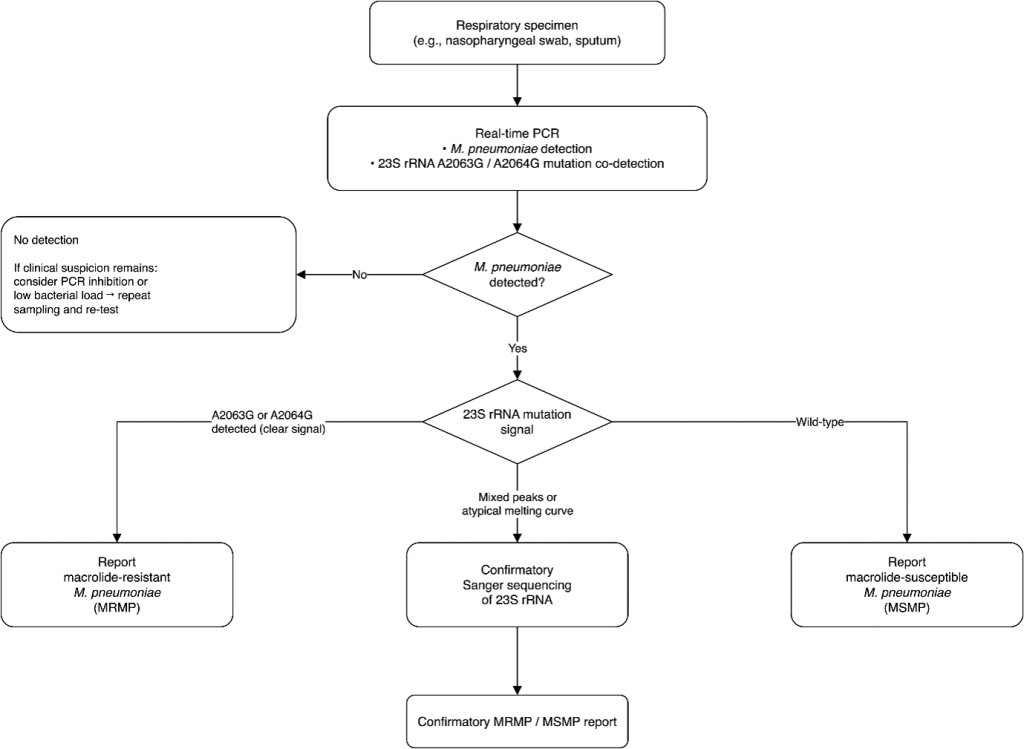
A range of molecular platforms that vary in target, specimen type, and turnaround time have been developed [24]. Real-time PCR detects 23S rRNA A2063G/A2064G mutations using probe-based melting or allele-specific approaches, and is the most widely adopted format for the simultaneous identification of M. pneumoniae and macrolide resistance mutations. The detection of all sequence variants requires additional Sanger sequencing after PCR, which is more cumbersome [25]. Therefore, a pragmatic clinical-laboratory algorithm proceeds in two steps: real-time PCR for primary identification with simultaneous 23S rRNA mutation detection, followed by confirmatory sequencing of samples with mixed peaks, atypical melting curves, or non-targeted variants.

In Korea, the need for assays that simultaneously identify M. pneumoniae and detect macrolide resistance is recognized. A case report of two siblings with MRMP carrying A2063G was confirmed by direct sequencing [26], and a multicenter analysis of 195 specimens from primary and tertiary centers demonstrated a significantly higher positivity rate at primary centers (12.1%) than at tertiary centers (2.8%; P = 0.033), highlighting the clinical need for an integrated assay combining the detection of M. pneumoniae with the simultaneous evaluation of 23S rRNA A2063G [27].

The absence of a 23S rRNA mutation did not necessarily indicate macrolide susceptibility. The sensitivity of PCR assays for M. pneumoniae detection ranges from 80% to 100%, depending on the assay and specimen quality [28], and false-negative results have been attributed to low bacterial load, suboptimal sample collection, and transport conditions; sample-matrix-derived PCR inhibitors can be flagged by internal controls and partly mitigated by inhibitor removal during sputum processing [29]. Heteroresistance, the coexistence of wild-type and mutant M. pneumoniae subpopulations within a single clinical sample, poses a further interpretative challenge; mixed populations have been reported in up to 41.4% of macrolide-resistant samples by next-generation sequencing (NGS), with minority resistant variants potentially missed by Sanger sequencing alone [21]. Therefore, atypical signals or mixed peaks should prompt confirmatory sequencing or repeat testing (Fig. 1).

Fig. 1. Practical molecular diagnostic algorithm for macrolide-resistant Mycoplasma pneumoniae in the routine clinical microbiology laboratory. PCR, polymerase chain reaction.

In emergency settings and at the time of pediatric admission decisions, results within 24–48 h are decisive. A 3D-printed microfluidic qPCR platform has been reported to perform sample-to-answer identification of M. pneumoniae together with A2063G/A2064G detection within 80 min [24]. Future cartridge-based point-ofcare platforms that incorporate 23S rRNA mutation detection into their standard panels could enable targeted antimicrobial selection, even in emergency settings.

NGS

M. pneumoniae-specific capture-based targeted metagenomic sequencing (tNGS) is emerging as a next-generation surveillance platform that simultaneously analyzes whole-genome content and macrolide resistance variants directly from PCR-positive specimens without culture. However, practical limitations persist, such as the limited feasibility of testing small numbers of samples and turnaround times of several days, which may not be sufficient for routine clinical laboratory use. Tam et al. [7] recovered 124 high-quality genomes from 356 PCR-positive specimens collected nationally in Australia and reported a predominance of P1 type 1 (69%), the appearance of ST3 and ST14, and the finding that all detected resistant isolates (13%) belonged to the ST3 or ST14 lineages. Thus, a single workflow can deliver (i) species identification, (ii) macrolide resistance variants, (iii) P1 typing, (iv) multilocus sequence typing (MLST), and (v) global phylogenetic placement, dramatically improving surveillance efficiency by eliminating resource-intensive culture steps. In France, multiplex amplicon sequencing simultaneously targeting 23S/16S rRNA, rplD/rplV (L4/L22), and gyrA/parC has enabled broad resistance screening in a single run [21], showing targeted NGS as a central tool for comprehensive resistance surveillance.

Global epidemiology

Global prevalence

A meta-analysis of 98 studies and 17,873 isolates from 2000 to 2020 documented striking regional variations in the prevalence of MRMP: 63% in Asia, 8.6% in North America, 3% in Europe, 3.3% in Oceania, and 0% in South America [30]. A complementary trend analysis confirmed the predominance of 23S rRNA A2063G (96.8%) and A2064G (4.8%), and a higher pooled MRMP prevalence among pediatric studies (37%) than in adult studies (15.9%) [9].

East Asia

In Beijing, China, the mean MRMP reached 90.6% during 2008–2012 [31], and a 2018–2024 children’s hospital cohort showed that M. pneumoniae positivity dropped to the lowest level of 17.0% in 2021, before rebounding to 62.8% by 2024, whereas MRMP reached 96.9% and remained above 95% since 2022 [32]. In Korea, resistance increased from 2.9% in 2003 to 62.9% in 2011 [10] and reached 87.2% in 2015 [33], remaining at 78.4% in a 2018–2020 multicenter cohort of 1,063 patients [34] and 87.0% in a 13-hospital cohort [28], among the highest sustained levels worldwide (Table 1). In contrast, Japan and Taiwan have shown sharp declines: in Japan, during the period of ST3 and ST14 dominance (2002–2016), MRMP exceeded 80% during the 2011–2012 epidemic but fell sharply to approximately 11% in 2018–2019 as the susceptible STs ST7 and ST33 displaced the previously dominant lineages [35,36]; in Taiwan, MRMP rose to 85.7% in 2020 and then collapsed to 0% during the 2022–2023 COVID-19 period [37].


Table 1. Trend of macrolide-resistant Mycoplasma pneumoniae prevalence and dominant sequence types in Korea

PeriodSample (n)MRMP prevalence (%)Dominant ST / cloneNotesReference
2000–2011
(longitudinal)
2,089 specimens / 255 MP+ / 80 with mutation2.9 (2003) → 62.9 (2011)Not typedNational longitudinal trend[10]
2010
(Oct–Nov)
195 / 17 MP+17.6 (3/17, A2063G)Not typedMP positive in primary clinic (12.1%) vs. tertiary hospital (2.8%)[27]
201594 patients87.2 (82/94)Not typedPediatric; A2063G dominant[33]
2018–20201,063 enrolled / 454 MP+78.4 (all A2063G)Not typedProspective multicenter[34]
2019–20201,228 specimens / 93 MP+Overall 78.5 (73/93); ST3 98.5%; ST14 38.9%ST3 71.0% / ST14 19.4% (3 novel STs)4 hospitals; ST3 → ST14 transition[45]
2023
(Sep–Dec)
474 screened / 374 confirmed87.0Not typed13 major hospitals; corticosteroid co-prescription 55.6%[28]

Not typed indicates that sequence typing was not performed in the original study. Abbreviations: MP, Mycoplasma pneumoniae; MRMP, macrolide-resistant Mycoplasma pneumoniae; ST, sequence type.

The contrast is stark: Korea and China remain locked into high-level resistance, whereas Japan and Taiwan show distinct downward trajectories— unmistakable East Asian decoupling. Ouchi et al. [5] attributed the Japanese decline to (i) the 2011 pediatric guidelines approving tosufloxacin and a subsequent national antimicrobial resistance action plan that reduced macrolide consumption by 47.5% between 2013 and 2021 and (ii) herd-immunity-driven turnover of the P1 genotype from type 1 (MRMP) to type 2 (macrolide-susceptible M. pneumoniae). The Japanese and Taiwanese experiences constitute a natural experiment demonstrating that combined reductions in prescribing pressure and natural immune dynamics can reverse resistance within a short timeframe, suggesting that integrating macrolide-prescribing surveillance with molecular typing surveillance in Korea could provide a critical evidence base for a stewardship policy.

United States and Europe

MRMP has remained at relatively low levels of 2%–10% in the United States [13,38,39]. However, in a recent pediatric cohort in Ohio, the post-pandemic resurgence of M. pneumoniae was accompanied by monthly MRMP fluctuations between 0% and 8.7%, which directly mirrored the community azithromycin prescribing during the same period [40]. This finding suggests that the relative prevalence of resistant strains can be determined within a short timescale by community-level prescribing pressure rather than by the importation of external strains alone, and offers a real-time platform for evaluating antimicrobial stewardship interventions. The authors further concluded that real-time MRMP surveillance provides actionable information for the management of pediatric M. pneumoniae infections, underscoring the bidirectional link between laboratory-based surveillance and prescribing policies. In Europe, MRMP has been reported at 26% in Italy (2010), 8% in Spain (2013–2017), 9.3% in the United Kingdom, 3.4%–8.3% in France, and below 4% in Germany and Scandinavia, generally at low levels. The prevalence of MRMP in Europe has been epidemic wave-dependent, peaking in Italy and Scotland during the 2010–2011 epidemic and remaining undetected in Finland and the Netherlands. In the Italian 2010 outbreak, both A2063G and A2064G mutations were detected, with three patients initially carrying susceptible genotypes acquiring A2063G during hospitalization [41,42].

Impact of COVID-19 and post-pandemic resurgence

After non-pharmaceutical interventions (NPIs; e.g., masking, physical distancing, school closures, and travel restrictions) were introduced in 2020, the global M. pneumoniae detection rate fell sharply from 8.61% to 1.69%; within the same surveillance, the proportion of MRMP also declined, from 176 of 762 detections (23.10%) to 1 of 22 (4.55%), suggesting that NPIs were associated not only with reduced transmission but also with a temporary release of selection pressure for resistant strains [43]. From the second half of 2023, however, a strong resurgence centered in East Asia was reported [5]. A 24-country, 45-sentinel-site analysis showed that the global detection rate rose approximately fivefold from a mean of 0.82% from April 2022 to March 2023 to 4.12% from April to September 2023, and Beijing Children’s Hospital documented a parallel rebound in M. pneumoniae positivity from 17.0% (2021) to 62.8% (2024) [32]. In Shanghai during 2023, a cohort of 38,668 patients with lower respiratory tract infections identified 11,919 M. pneumoniae-positive cases, with the highest prevalence of P1 type 1 and MRMP strains in children aged 5–10 years. Notably, neutralizing antibody titers against the most recent H3N2 influenza were significantly elevated in the M. pneumoniae-positive group, while lymphocyte, basophil, and eosinophil counts were reduced, and C-reactive protein (CRP), neutrophil, and monocyte counts were elevated, suggesting that recent H3N2 infection may potentiate M. pneumoniae susceptibility through respiratory epithelial inflammation and modulation of host immunity. Within the same cohort, no such elevation was observed for influenza A H1N1pdm09 or SARS-CoV-2 Omicron variants, suggesting a possible H3N2-specific association; the authors proposed that H3N2-induced respiratory epithelial damage and host immune modulation may facilitate subsequent M. pneumoniae infection [44]. These findings argue for surveillance that goes beyond a single pathogen to track sequential and co-infection dynamics with respiratory viruses, and from a laboratory perspective, they highlight the need for integrated operation of respiratory virus panels with M. pneumoniae molecular assays as well as attention to biomarkers such as complete blood count and CRP.

Molecular typing and clonal dynamics

Molecular typing is a key tool in elucidating the drivers of M. pneumoniae resistance epidemiology. The field has progressed from PCR-based DNA fingerprinting in the 1990s to restriction fragment length polymorphism analysis of the RepMP regions of the P1 gene (MPN141), multilocus variable-number tandem repeat analysis (MLVA), MLST, and single nucleotide polymorphism typing [25]. Recently, tNGS was introduced as a next-generation surveillance tool that simultaneously analyzes the whole-genome content and macrolide resistance variants directly from PCR-positive specimens [7]. Molecular typing surveillance (i) provides early detection of the emergence and dissemination of novel clones, (ii) clarifies the causal links between prescribing pressure and clonal dynamics, and (iii) monitors the natural dynamics of herd immunitydriven turnover, providing a critical evidence base for stewardship policies.

The increase in macrolide resistance in Korea resulted from clonal expansion of specific STs rather than from sporadic mutation events. The rapid expansion of ST3 clones has been observed in Korean MRMP isolates [6]. In contrast, in Japan, the dominance of ST3 and ST14 was replaced after 2018 by a type shift to susceptible lineages ST7 and ST33, accompanied by a sharp decline in resistance [35]. A subsequent Korean study (2019–2020) recovered 93 culture-positive isolates from 1,228 respiratory specimens and reported, by MLST, ST3 in 71.0% and ST14 in 19.4% of cases, indicating a transition from single ST3 dominance to a significant increase in ST14, with markedly different macrolide resistance rates of 98.5% for ST3 and 38.9% for ST14 [45]. This ST3 to ST14 transition raises the possibility that herd immunity to a single ST3 clone in Korea enables niche expansion of ST14. Whether the resistance rate in ST14 increases in subsequent years may become the central surveillance indicator of MRMP dynamics in Korea.

WGS-based surveillance surpasses MLVA and MLST as next-generation tools because it (i) tracks clonal dynamics at a single-nucleotide resolution, (ii) analyzes multiple targets—23S rRNA, L4, L22, and gyrA/ parC—within a single workflow, and (iii) reconstructs regional importation and dissemination pathways within global phylogenies. Australian tNGS analysis recovered 124 high-quality genomes, reported P1 type 1 in 69% and MRMP in 13%, found that all detected resistant isolates belonged to ST3 or ST14 lineages, and inferred from phylogenetic analysis that they were possibly imported East Asian resistant clones rather than autochthonous Australian ancestral lineages [7].

In China, MLVA M4572 in Beijing remained dominant at 70.77% during 2016–2019, although its proportion declined from 84.49%, whereas the proportion of M3562 increased from 11.63% to 24.67%, and macrolide resistance within M3562 increased from 60% to 93.48%, illustrating clonal selection under macrolide exposure pressure [46]. In a post-COVID outbreak in Baoding, M3562 emerged as the dominant type at 74%, accompanied by 92.7% macrolide resistance and clinical features such as elevated D-dimer and lactate dehydrogenase [47].

These Asian-origin ST3 and ST14 resistant clones have recently disseminated to other continents. In Canada, the reversal from P1-2 to P1-1 dominance began before the pandemic (P1-1 78.3% during 20132020) and persisted through the 2024–2025 outbreak with P1-1 dominance at 81%. Macrolide resistance was significantly higher in P1-1 isolates (29.9%) than in P1-2 (7.7%) [48]. In Iran, resistance reached 85.1%, and 50% of the resistant isolates were ST3 [49], indicating accelerated global dispersal. A global meta-analysis identified P1-1, M4572, and ST3 as the principal resistant genotypes worldwide [8].

Conclusion and future perspectives

Macrolide resistance in M. pneumoniae is principally driven by point mutations centered on 23S rRNA A2063G, and the overwhelming East Asian resistance burden, together with post-pandemic resurgence, has elevated the role of the clinical microbiology laboratory to an unprecedented level of importance. Reference laboratories at the regional level should establish integrated tNGS-based surveillance covering P1 typing, MLST, and resistance variants to enable the early detection of emerging clones and global dispersal [7]. In parallel, clinical laboratories in hospitals can provide real-time PCR-based detection of M. pneumoniae with simultaneous 23S rRNA mutation testing to guide empirical macrolide therapy at the point of care. Respiratory virus multiplex panels and M. pneumoniae molecular assays should be operated in an integrated fashion, and exposure histories such as recent H3N2 infections should be linked to surveillance data to track sequential and co-infection dynamics [44]. The Japanese and Taiwanese experiences demonstrate that reductions in macrolide consumption strengthened molecular surveillance and can effectively reverse resistance rates. Therefore, sustained efforts by clinical microbiology laboratories to monitor and survey antimicrobial resistance can make a decisive contribution to antimicrobial stewardship and improve patient outcomes.

Ethics statement

This study did not involve human subjects; therefore, Institutional Review Board approval and informed consent were not required.

Conflicts of interest

No potential conflict of interest relevant to this article was reported.

Funding

None.

Data availability

Data sharing is not applicable to this article as no new data were created or analyzed in this study.

References

1. Douvoyiannis M. Macrolide-resistant Mycoplasma pneumoniae in children: emphasis on the United States. Clin Pediatr (Phila) 2025;64:1169-74.

2. Antonakos N, Giamarellos-Bourboulis EJ, Niederman MS. The role of macrolides in severe community-acquired pneumonia and the potential impact of macrolide-resistant Mycoplasma pneumoniae. Curr Opin Infect Dis 2025;38:190-7.

3. Lanata MM, Wang H, Everhart K, Moore-Clingenpeel M, Ramilo O, Leber A. Macrolideresistant Mycoplasma pneumoniae infections in children, Ohio, USA. Emerg Infect Dis 2021;27:1588-97.

4. Yang S, Liu X, Han Y, Wang H, Mei Y, Wang H, et al. Clinical characteristics and associated factors of macrolide-resistant Mycoplasma pneumoniae pneumonia in children: a systematic review and meta-analysis. Eur J Clin Microbiol Infect Dis 2025;44:1505-22.

5. Ouchi K and Oishi T. Recent global trends of macrolide-resistant Mycoplasma pneumoniae: why has the macrolide-resistant rate decreased in Japan? Pediatr Infect Dis J 2025;44:e446-e9.

6. Lee JK, Lee JH, Lee H, Ahn YM, Eun BW, Cho EY, et al. Clonal expansion of macrolideresistant sequence type 3 Mycoplasma pneumoniae, South Korea. Emerg Infect Dis 2018;24:1465-71.

7. Tam KK, Suster CJE, Fong W, Golubchik T, Sivalingam V, Jeoffreys N, et al. Genomic surveillance reveals emergence and spread of macrolide-resistant Mycoplasma pneumoniae in Australia during the 2023-2024 epidemic. J Infect Dis 2026;jiag163. online ahead of print.

8. Zhu X, Tang Y, Spruyt K, Estill J, Florez ID, Amer YS, et al. Global molecular epidemiology of Mycoplasma pneumoniae and its association with macrolide resistance and disease severity: a systematic review and meta-analysis. Emerg Microbes Infect 2026;15:2614742.

9. Kim K, Jung S, Kim M, Park S, Yang HJ, Lee E. Global trends in the proportion of macrolideresistant Mycoplasma pneumoniae infections: a systematic review and meta-analysis. JAMA Netw Open 2022;5:e2220949.

10. Hong KB, Choi EH, Lee HJ, Lee SY, Cho EY, Choi JH, et al. Macrolide resistance of Mycoplasma pneumoniae, South Korea, 2000-2011. Emerg Infect Dis 2013;19:1281-4.

11. Miyashita N, Ogata M, Fukuda N, Yamura A, Ito T. Macrolide-resistant Mycoplasma pneumoniae infection prevalence increases again in Osaka. Respir Investig 2025;63:517-20.

12. Yan C, Chen Y, Ren X, Jia X, Du B, Zhao H, et al. In vitro antimicrobial susceptibility of Mycoplasma pneumoniae isolates across different regions of China in 2023. JAC Antimicrob Resist 2025;7:dlaf124.

13. Waites KB, Ratliff A, Crabb DM, Xiao L, Qin X, Selvarangan R, et al. Macrolide-resistant Mycoplasma pneumoniae in the United States as determined from a national surveillance program. J Clin Microbiol 57:10.1128/jcm.00968-19.

14. Korneenko EV, Rog IS, Chudinov IK, Kozyreva AI, Sandanova DA, Pavlenko AV, et al. Genomic surveillance of the pneumonia outbreak caused by Mycoplasma pneumoniae among patients in Russia from January 2024 to June 2025. Front Cell Infect Microbiol 2026;16:1736929.

15. Rivaya B, Jordana-Lluch E, Fernández-Rivas G, Molinos S, Campos R, Méndez-Hernández M, et al. Macrolide resistance and molecular typing of Mycoplasma pneumoniae infections during a 4 year period in Spain. J Antimicrob Chemother 2020;75:2752-9.

16. Huang C, Yang J, Cao J, Ren H, Gao N, Liu J. Antimicrobial susceptibility and molecular characteristics of Mycoplasma pneumoniae isolates from children in Xi’an regions of China. Front Pediatr 2025;13:1660687.

17. Jiang FC, Wang RF, Chen P, Dong LY, Wang X, Song Q, et al. Genotype and mutation patterns of macrolide resistance genes of Mycoplasma pneumoniae from children with pneumonia in Qingdao, China, in 2019. J Glob Antimicrob Resist 2021;27:273-8.

18. Wang N, Xu X, Xiao L, Liu Y. Novel mechanisms of macrolide resistance revealed by in vitro selection and genome analysis in Mycoplasma pneumoniae. Front Cell Infect Microbiol 2023;13:1186017.

19. Xie P, Zhang Y, Qin Y, Fang Y, Yang N, Bai Y, et al. Macrolide resistance in Mycoplasma pneumoniae in adult patients. Front Cell Infect Microbiol 2025;15:1496521.

20. Lee JK, Seong MW, Yun KW, Choi EH. Association of tandem repeat number variabilities in subunit S of the type I restriction-modification system with macrolide resistance in Mycoplasma pneumoniae. J Clin Med 2022;11:715.

21. Guiraud J, Ginevra C, Laurier-Nadalié C, Balcon C, Semanas Q, Gardette M, et al. Multiplex amplicon sequencing reveals polyclonality and low macrolide resistance in the French Mycoplasma pneumoniae outbreak, 2023-2024. Int J Infect Dis 2026;166:108506.

22. Yun KW. Growing threat of macrolide-resistant Mycoplasma pneumoniae among children: what we know and what we need. J Korean Med Sci 2025;40:e317.

23. Xie P, Liu J, Feng Y, Zhao T, Niu W, Fang Y, et al. Evolution and characteristics of tetracycline resistance in Mycoplasma pneumoniae. Microbiol Spectr 2025;13:e03398-24.

24. Wang A, Wu Z, Huang Y, Zhou H, Wu L, Jia C, et al. A 3D-printed microfluidic device for qPCR detection of macrolide-resistant mutations of Mycoplasma pneumoniae. Biosensors (Basel) 2021;11:427.

25. Dumke R. Molecular tools for typing Mycoplasma pneumoniae and mycoplasma genitalium. Front Microbiol 2022;13:904494.

26. Hong JH, Chun JK, Uh Y, Oh KJ, Kim J, Yoon KJ. Two cases of Mycoplasma pneumoniae pneumonia with A2063G mutation in the 23S rRNA gene in siblings. Ann Lab Med 2013;33:65-8.

27. Uh Y, Hong JH, Oh KJ, Cho HM, Park SD, Kim J, et al. Macrolide resistance of Mycoplasma pneumoniae and its detection rate by real-time PCR in primary and tertiary care hospitals. Ann Lab Med 2013;33:410-4.

28. Lee JK, Lee T, Kim YJ, Kim DR, Shin A, Kang HM, et al. Clinical manifestations, macrolide resistance, and treatment utilization trends of Mycoplasma pneumoniae pneumonia in children and adolescents in South Korea. Microorganisms 2024;12:1806.

29. Cho MC, Kim H, An D, Lee M, Noh SA, Kim MN, et al. Comparison of sputum and nasopharyngeal swab specimens for molecular diagnosis of Mycoplasma pneumoniae, Chlamydophila pneumoniae, and Legionella pneumophila. Ann Lab Med 2012;32:133-8.

30. Wang G, Wu P, Tang R, Zhang W. Global prevalence of resistance to macrolides in Mycoplasma pneumoniae: a systematic review and meta-analysis. J Antimicrob Chemother 2022;77:2353-63.

31. Zhao F, Liu G, Wu J, Cao B, Tao X, He L, et al. Surveillance of macrolide-resistant Mycoplasma pneumoniae in Beijing, China, from 2008 to 2012. Antimicrob Agents Chemother 2013;57:1521-3.

32. Chen W, Qi H, Jiao W, Guo Y, Wang Y, Liu J, et al. Etiological characteristics of Mycoplasma pneumoniae infection and macrolide resistance in children in Beijing: a retrospective study from 2018 to 2024. Eur J Clin Microbiol Infect Dis 2025;44:2779-91.

33. Lee E, Cho HJ, Hong SJ, Lee J, Sung H, Yu J. Prevalence and clinical manifestations of macrolide resistant Mycoplasma pneumoniae pneumonia in Korean children. Korean J Pediatr 2017;60:151-7.

34. Sung M, Roh EJ, Lee ES, Lee JY, Kim HB, Ahn Y, et al. Assessment of variables associated with prolonged admission duration in children with Mycoplasma pneumoniae pneumonia. Clin Respir J 2022;16:756-67.

35. Morozumi M, Tajima T, Sakuma M, Shouji M, Meguro H, Saito K, et al. Sequence type changes associated with decreasing macrolide-resistant Mycoplasma pneumoniae, Japan. Emerg Infect Dis 2020;26:2210-3.

36. Oishi T and Ouchi K. Recent trends in the epidemiology, diagnosis, and treatment of macrolide-resistant Mycoplasma pneumoniae. J Clin Med 2022;11:1782.

37. Wu TH, Fang YP, Liu FC, Pan HH, Yang YY, Song CS, et al. Macrolide-resistant Mycoplasma pneumoniae infections among children before and during COVID-19 pandemic, Taiwan, 2017-2023. Emerg Infect Dis 2024;30:1692-6.

38. Rothstein TE, Cunningham SA, Rieke RA, Mainella JM, Mutchler MM, Patel R. Macrolide resistance in Mycoplasma pneumoniae, Midwestern United States, 2014 to 2021. Antimicrob Agents Chemother 2022;66:e02432-21.

39. Leber AL, Embry T, Everhart K, Taveras J, Oyeniran SJ, Wang H. Macrolide-resistant Mycoplasma pneumoniae infections among children after COVID-19 pandemic, Ohio, USA. Emerg Infect Dis 2025;31:555-8.

40. Wang H, Embry T, Everhart K, Szekely M, Taveras J, Oyeniran SJ, et al. Macrolide-resistant Mycoplasma pneumoniae in Children, Ohio, USA. Emerg Infect Dis 2025;31:2341-3.

41. Chironna M, Sallustio A, Esposito S, Perulli M, Chinellato I, Di Bari C, et al. Emergence of macrolide-resistant strains during an outbreak of Mycoplasma pneumoniae infections in children. J Antimicrob Chemother 2011;66:734-7.

42. Loconsole D, De Robertis AL, Sallustio A, Centrone F, Morcavallo C, Campanella S, et al. Update on the epidemiology of macrolide-resistant Mycoplasma pneumoniae in Europe: a systematic review. Infect Dis Rep 2021;13:811-20.

43. Meyer Sauteur PM, Beeton ML, Uldum SA, Bossuyt N, Vermeulen M, Loens K, et al. Mycoplasma pneumoniae detections before and during the COVID-19 pandemic: results of a global survey, 2017 to 2021. Euro Surveill 2022;27:2100746.

44. Chen J, Wang Y, Cheng J, Ma Y, Zhang X, Bai X, et al. Synergistic impact of macrolide resistance and H3N2 infection on M. pneumoniae outbreak in children. Microbiol Spectr 2025;13:e01844-24.

45. Lee JK, Choi YY, Sohn YJ, Kim KM, Kim YK, Han MS, et al. Persistent high macrolide resistance rate and increase of macrolide-resistant ST14 strains among Mycoplasma pneumoniae in South Korea, 2019-2020. J Microbiol Immunol Infect 2022;55:910-6.

46. Wang Y, Xu B, Wu X, Yin Q, Wang Y, Li J, et al. Increased macrolide resistance rate of M3562 Mycoplasma pneumoniae correlated with macrolide usage and genotype shifting. Front Cell Infect Microbiol 2021;11:675466.

47. Jiang TT, Sun L, Wang TY, Qi H, Tang H, Wang YC, et al. The clinical significance of macrolide resistance in pediatric Mycoplasma pneumoniae infection during COVID-19 pandemic. Front Cell Infect Microbiol 2023;13:1181402.

48. Fatima Z, Jayaratne P, Arrabi A, Rutherford C, Leto D, Smieja M, et al. Macrolide resistance and P1 cytadhesin genotyping of Mycoplasma pneumoniae during outbreak, Canada, 20242025. Emerg Infect Dis 2025;31:2316-9.

49. Arfaatabar M, Sadeghi Y, Goodarzi NN, Pourmand MR. Molecular insights into macrolide resistant Mycoplasma pneumoniae isolates from outpatient clinics in Tehran, Iran. Sci Rep 2026;16:7432.
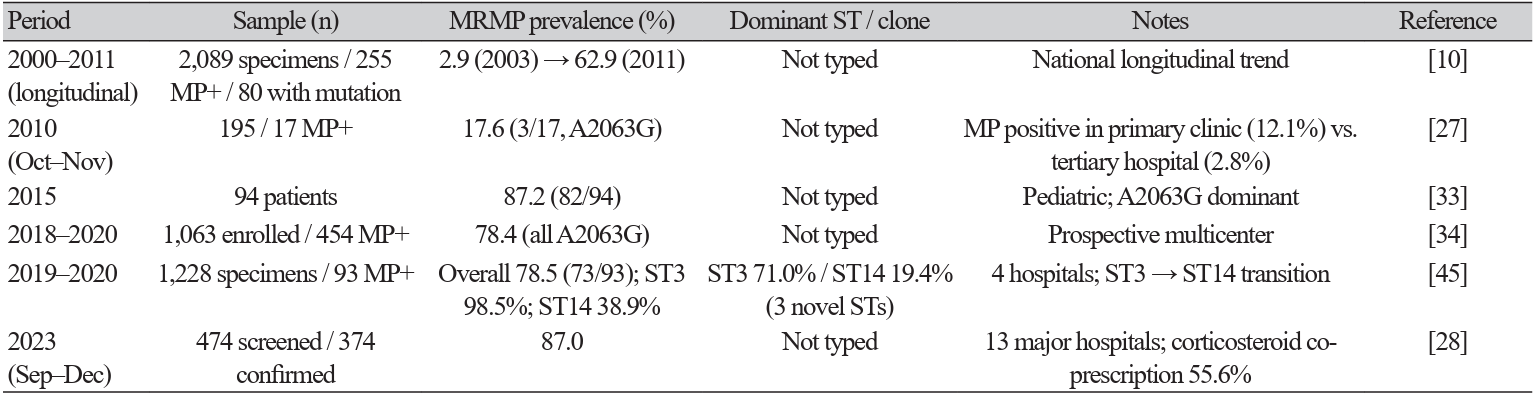
Figure 1
Table 1

1. Douvoyiannis M. Macrolide-resistant Mycoplasma pneumoniae in children: emphasis on the United States. Clin Pediatr (Phila) 2025;64:1169-74.

2. Antonakos N, Giamarellos-Bourboulis EJ, Niederman MS. The role of macrolides in severe community-acquired pneumonia and the potential impact of macrolide-resistant Mycoplasma pneumoniae. Curr Opin Infect Dis 2025;38:190-7.

3. Lanata MM, Wang H, Everhart K, Moore-Clingenpeel M, Ramilo O, Leber A. Macrolideresistant Mycoplasma pneumoniae infections in children, Ohio, USA. Emerg Infect Dis 2021;27:1588-97.

4. Yang S, Liu X, Han Y, Wang H, Mei Y, Wang H, et al. Clinical characteristics and associated factors of macrolide-resistant Mycoplasma pneumoniae pneumonia in children: a systematic review and meta-analysis. Eur J Clin Microbiol Infect Dis 2025;44:1505-22.

5. Ouchi K and Oishi T. Recent global trends of macrolide-resistant Mycoplasma pneumoniae: why has the macrolide-resistant rate decreased in Japan? Pediatr Infect Dis J 2025;44:e446-e9.

6. Lee JK, Lee JH, Lee H, Ahn YM, Eun BW, Cho EY, et al. Clonal expansion of macrolideresistant sequence type 3 Mycoplasma pneumoniae, South Korea. Emerg Infect Dis 2018;24:1465-71.

7. Tam KK, Suster CJE, Fong W, Golubchik T, Sivalingam V, Jeoffreys N, et al. Genomic surveillance reveals emergence and spread of macrolide-resistant Mycoplasma pneumoniae in Australia during the 2023-2024 epidemic. J Infect Dis 2026;jiag163. online ahead of print.

8. Zhu X, Tang Y, Spruyt K, Estill J, Florez ID, Amer YS, et al. Global molecular epidemiology of Mycoplasma pneumoniae and its association with macrolide resistance and disease severity: a systematic review and meta-analysis. Emerg Microbes Infect 2026;15:2614742.

9. Kim K, Jung S, Kim M, Park S, Yang HJ, Lee E. Global trends in the proportion of macrolideresistant Mycoplasma pneumoniae infections: a systematic review and meta-analysis. JAMA Netw Open 2022;5:e2220949.

10. Hong KB, Choi EH, Lee HJ, Lee SY, Cho EY, Choi JH, et al. Macrolide resistance of Mycoplasma pneumoniae, South Korea, 2000-2011. Emerg Infect Dis 2013;19:1281-4.

11. Miyashita N, Ogata M, Fukuda N, Yamura A, Ito T. Macrolide-resistant Mycoplasma pneumoniae infection prevalence increases again in Osaka. Respir Investig 2025;63:517-20.

12. Yan C, Chen Y, Ren X, Jia X, Du B, Zhao H, et al. In vitro antimicrobial susceptibility of Mycoplasma pneumoniae isolates across different regions of China in 2023. JAC Antimicrob Resist 2025;7:dlaf124.

13. Waites KB, Ratliff A, Crabb DM, Xiao L, Qin X, Selvarangan R, et al. Macrolide-resistant Mycoplasma pneumoniae in the United States as determined from a national surveillance program. J Clin Microbiol 57:10.1128/jcm.00968-19.

14. Korneenko EV, Rog IS, Chudinov IK, Kozyreva AI, Sandanova DA, Pavlenko AV, et al. Genomic surveillance of the pneumonia outbreak caused by Mycoplasma pneumoniae among patients in Russia from January 2024 to June 2025. Front Cell Infect Microbiol 2026;16:1736929.

15. Rivaya B, Jordana-Lluch E, Fernández-Rivas G, Molinos S, Campos R, Méndez-Hernández M, et al. Macrolide resistance and molecular typing of Mycoplasma pneumoniae infections during a 4 year period in Spain. J Antimicrob Chemother 2020;75:2752-9.

16. Huang C, Yang J, Cao J, Ren H, Gao N, Liu J. Antimicrobial susceptibility and molecular characteristics of Mycoplasma pneumoniae isolates from children in Xi’an regions of China. Front Pediatr 2025;13:1660687.

17. Jiang FC, Wang RF, Chen P, Dong LY, Wang X, Song Q, et al. Genotype and mutation patterns of macrolide resistance genes of Mycoplasma pneumoniae from children with pneumonia in Qingdao, China, in 2019. J Glob Antimicrob Resist 2021;27:273-8.

18. Wang N, Xu X, Xiao L, Liu Y. Novel mechanisms of macrolide resistance revealed by in vitro selection and genome analysis in Mycoplasma pneumoniae. Front Cell Infect Microbiol 2023;13:1186017.

19. Xie P, Zhang Y, Qin Y, Fang Y, Yang N, Bai Y, et al. Macrolide resistance in Mycoplasma pneumoniae in adult patients. Front Cell Infect Microbiol 2025;15:1496521.

20. Lee JK, Seong MW, Yun KW, Choi EH. Association of tandem repeat number variabilities in subunit S of the type I restriction-modification system with macrolide resistance in Mycoplasma pneumoniae. J Clin Med 2022;11:715.

21. Guiraud J, Ginevra C, Laurier-Nadalié C, Balcon C, Semanas Q, Gardette M, et al. Multiplex amplicon sequencing reveals polyclonality and low macrolide resistance in the French Mycoplasma pneumoniae outbreak, 2023-2024. Int J Infect Dis 2026;166:108506.

22. Yun KW. Growing threat of macrolide-resistant Mycoplasma pneumoniae among children: what we know and what we need. J Korean Med Sci 2025;40:e317.

23. Xie P, Liu J, Feng Y, Zhao T, Niu W, Fang Y, et al. Evolution and characteristics of tetracycline resistance in Mycoplasma pneumoniae. Microbiol Spectr 2025;13:e03398-24.

24. Wang A, Wu Z, Huang Y, Zhou H, Wu L, Jia C, et al. A 3D-printed microfluidic device for qPCR detection of macrolide-resistant mutations of Mycoplasma pneumoniae. Biosensors (Basel) 2021;11:427.

25. Dumke R. Molecular tools for typing Mycoplasma pneumoniae and mycoplasma genitalium. Front Microbiol 2022;13:904494.

26. Hong JH, Chun JK, Uh Y, Oh KJ, Kim J, Yoon KJ. Two cases of Mycoplasma pneumoniae pneumonia with A2063G mutation in the 23S rRNA gene in siblings. Ann Lab Med 2013;33:65-8.

27. Uh Y, Hong JH, Oh KJ, Cho HM, Park SD, Kim J, et al. Macrolide resistance of Mycoplasma pneumoniae and its detection rate by real-time PCR in primary and tertiary care hospitals. Ann Lab Med 2013;33:410-4.

28. Lee JK, Lee T, Kim YJ, Kim DR, Shin A, Kang HM, et al. Clinical manifestations, macrolide resistance, and treatment utilization trends of Mycoplasma pneumoniae pneumonia in children and adolescents in South Korea. Microorganisms 2024;12:1806.

29. Cho MC, Kim H, An D, Lee M, Noh SA, Kim MN, et al. Comparison of sputum and nasopharyngeal swab specimens for molecular diagnosis of Mycoplasma pneumoniae, Chlamydophila pneumoniae, and Legionella pneumophila. Ann Lab Med 2012;32:133-8.

30. Wang G, Wu P, Tang R, Zhang W. Global prevalence of resistance to macrolides in Mycoplasma pneumoniae: a systematic review and meta-analysis. J Antimicrob Chemother 2022;77:2353-63.

31. Zhao F, Liu G, Wu J, Cao B, Tao X, He L, et al. Surveillance of macrolide-resistant Mycoplasma pneumoniae in Beijing, China, from 2008 to 2012. Antimicrob Agents Chemother 2013;57:1521-3.

32. Chen W, Qi H, Jiao W, Guo Y, Wang Y, Liu J, et al. Etiological characteristics of Mycoplasma pneumoniae infection and macrolide resistance in children in Beijing: a retrospective study from 2018 to 2024. Eur J Clin Microbiol Infect Dis 2025;44:2779-91.

33. Lee E, Cho HJ, Hong SJ, Lee J, Sung H, Yu J. Prevalence and clinical manifestations of macrolide resistant Mycoplasma pneumoniae pneumonia in Korean children. Korean J Pediatr 2017;60:151-7.

34. Sung M, Roh EJ, Lee ES, Lee JY, Kim HB, Ahn Y, et al. Assessment of variables associated with prolonged admission duration in children with Mycoplasma pneumoniae pneumonia. Clin Respir J 2022;16:756-67.

35. Morozumi M, Tajima T, Sakuma M, Shouji M, Meguro H, Saito K, et al. Sequence type changes associated with decreasing macrolide-resistant Mycoplasma pneumoniae, Japan. Emerg Infect Dis 2020;26:2210-3.

36. Oishi T and Ouchi K. Recent trends in the epidemiology, diagnosis, and treatment of macrolide-resistant Mycoplasma pneumoniae. J Clin Med 2022;11:1782.

37. Wu TH, Fang YP, Liu FC, Pan HH, Yang YY, Song CS, et al. Macrolide-resistant Mycoplasma pneumoniae infections among children before and during COVID-19 pandemic, Taiwan, 2017-2023. Emerg Infect Dis 2024;30:1692-6.

38. Rothstein TE, Cunningham SA, Rieke RA, Mainella JM, Mutchler MM, Patel R. Macrolide resistance in Mycoplasma pneumoniae, Midwestern United States, 2014 to 2021. Antimicrob Agents Chemother 2022;66:e02432-21.

39. Leber AL, Embry T, Everhart K, Taveras J, Oyeniran SJ, Wang H. Macrolide-resistant Mycoplasma pneumoniae infections among children after COVID-19 pandemic, Ohio, USA. Emerg Infect Dis 2025;31:555-8.

40. Wang H, Embry T, Everhart K, Szekely M, Taveras J, Oyeniran SJ, et al. Macrolide-resistant Mycoplasma pneumoniae in Children, Ohio, USA. Emerg Infect Dis 2025;31:2341-3.

41. Chironna M, Sallustio A, Esposito S, Perulli M, Chinellato I, Di Bari C, et al. Emergence of macrolide-resistant strains during an outbreak of Mycoplasma pneumoniae infections in children. J Antimicrob Chemother 2011;66:734-7.

42. Loconsole D, De Robertis AL, Sallustio A, Centrone F, Morcavallo C, Campanella S, et al. Update on the epidemiology of macrolide-resistant Mycoplasma pneumoniae in Europe: a systematic review. Infect Dis Rep 2021;13:811-20.

43. Meyer Sauteur PM, Beeton ML, Uldum SA, Bossuyt N, Vermeulen M, Loens K, et al. Mycoplasma pneumoniae detections before and during the COVID-19 pandemic: results of a global survey, 2017 to 2021. Euro Surveill 2022;27:2100746.

44. Chen J, Wang Y, Cheng J, Ma Y, Zhang X, Bai X, et al. Synergistic impact of macrolide resistance and H3N2 infection on M. pneumoniae outbreak in children. Microbiol Spectr 2025;13:e01844-24.

45. Lee JK, Choi YY, Sohn YJ, Kim KM, Kim YK, Han MS, et al. Persistent high macrolide resistance rate and increase of macrolide-resistant ST14 strains among Mycoplasma pneumoniae in South Korea, 2019-2020. J Microbiol Immunol Infect 2022;55:910-6.

46. Wang Y, Xu B, Wu X, Yin Q, Wang Y, Li J, et al. Increased macrolide resistance rate of M3562 Mycoplasma pneumoniae correlated with macrolide usage and genotype shifting. Front Cell Infect Microbiol 2021;11:675466.

47. Jiang TT, Sun L, Wang TY, Qi H, Tang H, Wang YC, et al. The clinical significance of macrolide resistance in pediatric Mycoplasma pneumoniae infection during COVID-19 pandemic. Front Cell Infect Microbiol 2023;13:1181402.

48. Fatima Z, Jayaratne P, Arrabi A, Rutherford C, Leto D, Smieja M, et al. Macrolide resistance and P1 cytadhesin genotyping of Mycoplasma pneumoniae during outbreak, Canada, 20242025. Emerg Infect Dis 2025;31:2316-9.

49. Arfaatabar M, Sadeghi Y, Goodarzi NN, Pourmand MR. Molecular insights into macrolide resistant Mycoplasma pneumoniae isolates from outpatient clinics in Tehran, Iran. Sci Rep 2026;16:7432.